
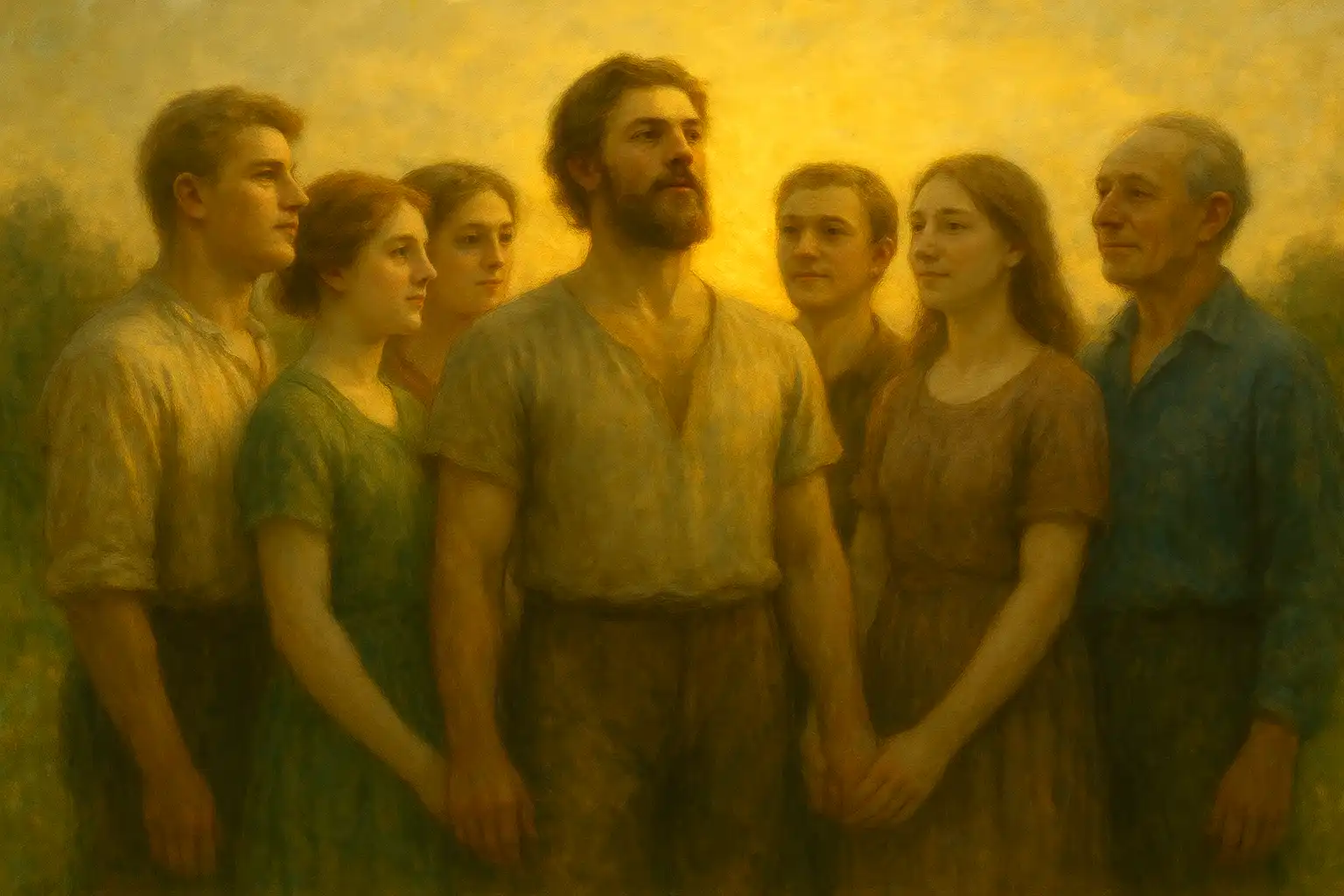
“I Sing the Body Electric” is Whitman at his boldest, and that’s saying something. First published in the 1855 edition of Leaves of Grass, this poem is basically Whitman standing up and yelling that the human body is sacred. Not metaphorically sacred. Actually sacred. In the 1850s, this was shocking. Most poetry tiptoed around the body or treated it like something shameful you had to transcend to reach spiritual truth. Whitman said nope, the body IS the spiritual truth.
The poem runs long and piles up detail after detail. He celebrates men and women, young and old, workers and athletes, every body in every form. Every gesture, every limb, every physical presence gets honored. And that word “electric” isn’t just decorative. It suggests the body is alive with energy, charged with something divine. The whole thing reads like Whitman walked into the room, saw everyone trying to pretend bodies don’t exist, and decided to write the loudest, most unapologetic celebration of flesh he possibly could.
Table of Contents:
Full Poem Text
Due to the length of this poem, we’ve placed the full text on a separate page. This keeps the article readable while still giving you access to the complete work.
Read the full poem here: I Sing the Body Electric by Walt Whitman
Summary and Meaning
The poem opens with that famous declaration: “I sing the body electric.” Right away, Whitman’s making his argument. The body isn’t something separate from the soul or lower than the soul. It’s electric, vital, sacred. From there, he launches into these massive catalogues of people and physical details. Men working, women moving, children playing, elderly folks living their lives. Every body gets attention and praise.
Whitman doesn’t rank bodies. He’s not saying athletes are better than workers, or young people are superior to old people, or men are more important than women. Everyone’s body is equally worthy of song. This democratic vision extends even to body parts. He lists arms, legs, muscles, blood, bones, all of it treated with the same reverence you might give to stars or mountains.
The poem also gets intimate in ways that made 1850s readers deeply uncomfortable. Whitman doesn’t hide behind metaphor or talk vaguely about “the human form.” He’s direct. Bodies touch, move, work, love. The physical reality of existence isn’t something to be ashamed of or transcended. It’s the whole point.
What’s he really saying? That you can’t separate body from soul. They’re not two different things where one is good and one is bad. They’re the same thing expressed in different ways. Your physical self isn’t a prison for your spirit. It IS your spirit, made visible, made real, made electric with life.
The meaning is both personal and political. Personally, it’s about accepting and celebrating your own physical existence. Politically, it’s about equality. If all bodies are sacred, then all people have inherent dignity regardless of their social status, gender, age, or anything else. The body becomes Whitman’s way of arguing for democracy at the most fundamental level.
Themes and Analysis
The Body as Sacred
This is the whole point of the poem. Whitman treats physical existence as holy. Not holy despite being physical, but holy BECAUSE it’s physical. Every part of the body, from major organs to fingernails, gets treated with reverence. This was radical. Christianity and most cultural thinking of his era said the body was fallen, corruptible, something you had to overcome. Whitman completely rejected that. To him, denying the body’s sacredness was denying half of what it means to be human.
Equality Through the Body
Whitman’s democracy isn’t abstract. It’s written into flesh. He celebrates male and female bodies equally (shocking for his time). He praises old bodies and young bodies, strong bodies and ordinary bodies, all with the same enthusiasm. No hierarchy, no ranking. The enslaved person’s body is as sacred as the president’s. This physical equality becomes the foundation for his political vision. If we’re all equally sacred at the level of flesh and bone, then social hierarchies start looking pretty arbitrary.
Body and Soul as One
The poem keeps insisting these aren’t separate categories. Traditional thinking said soul is high, body is low. Whitman says they’re two aspects of the same reality. The famous line “And if the body were not the soul, what is the soul?” isn’t rhetorical. He’s genuinely arguing that trying to separate them is nonsense. Your physical sensations, your movements, your presence in space—all of that IS your soul expressing itself. To celebrate one requires celebrating the other.
Energy and Vitality
That word “electric” does heavy lifting. In the 1850s, electricity was relatively new and mysterious, associated with vitality and almost magical power. Calling the body electric suggests it’s charged, alive with energy beyond just biological function. There’s something divine animating the flesh. The body isn’t dead matter moved by a separate soul. It’s fundamentally alive, fundamentally powerful.
Breaking Cultural Silence
Part of what makes the poem radical is simply its directness. Whitman refuses to whisper or use euphemisms. He talks about bodies plainly, celebrates them openly. This violated Victorian sensibilities that wanted bodies hidden, discussed only in abstract terms if at all. By speaking plainly about physical reality, Whitman was making a statement about honesty and cultural hypocrisy.
Structure and Form
The poem uses Whitman’s signature style: long, rolling free verse lines with no rhyme and no regular meter. It’s structured in nine numbered sections that move through different aspects of celebrating the body, but there’s no strict plot or argumentative progression. It’s more like a series of variations on the central theme.
Each section tends to feature catalogues where Whitman lists body parts, types of people, physical activities, or anatomical details. These catalogues pile up, creating a sense of abundance and overwhelming variety. The repetition and parallel structure (“The…” “The…” “The…”) create rhythm even without traditional meter.
The lines are famously long, sometimes stretching across multiple clauses. This creates a rolling, breathless quality, like Whitman can’t stop himself from adding more and more detail. The energy of the form matches the energy of the content—electric, vital, overflowing.
Section breaks give readers moments to pause and breathe before Whitman launches into another celebration. But within sections, the momentum builds. You get swept up in the accumulation of detail, the relentless positivity, the sheer volume of praise.
There’s also strategic use of direct address. Whitman speaks to the reader (“O my body!”), to bodies themselves, to specific figures. This creates intimacy, pulling you into the poem rather than letting you observe from a distance.
Historical and Literary Context
This poem appeared in the first edition of Leaves of Grass in 1855, when Whitman was self-publishing and basically unknown. America was heading toward Civil War, with slavery and questions of equality dominating politics. Whitman’s vision of all bodies as equally sacred was implicitly anti-slavery, though the poem doesn’t address that directly.
The Victorian era was in full swing, with strict codes about what could be discussed in polite society. The body, especially in sexual or sensual terms, was off-limits. Poetry was supposed to be elevated, spiritual, concerned with beauty and morality. Explicit physical detail was considered vulgar. Whitman blew right through those conventions.
His free verse style was equally radical. Most American poets still imitated British forms with regular rhyme and meter. Whitman’s long, unrhymed lines seemed chaotic or undisciplined to many critics. Some thought he wasn’t a real poet at all, just someone writing prose and calling it poetry.
The word “electric” had specific resonance. Electricity was cutting-edge technology in the 1850s, mysterious and powerful. Using it to describe the body suggested Whitman was connecting human vitality to modern energy and progress. It made the poem feel contemporary and scientific, not just mystical.
The poem influenced generations of later poets and writers. Allen Ginsberg, in particular, saw Whitman as giving permission to write openly about the body and sexuality. The poem’s impact extends beyond poetry into how American culture thinks about bodies, freedom, and expression.
Significance and Impact
This poem helped change what poetry could talk about and how it could talk about it. Before Whitman, American poetry mostly avoided direct discussion of the body. After “I Sing the Body Electric,” that silence started breaking down. He gave permission for later poets to write about physical existence without shame or euphemism.
The poem’s vision of equality remains powerful. By grounding democracy in the body rather than abstract rights or laws, Whitman made it concrete and undeniable. If we accept that all bodies are sacred, then discrimination based on gender, race, class, or any other category becomes absurd. The poem provided philosophical ammunition for equality movements.
It also challenged religious and cultural assumptions about the relationship between body and soul. Whitman’s insistence that they’re unified rather than opposed offered an alternative to the dominant mind/body dualism. This influenced American spirituality, helping create space for more embodied, physical approaches to the sacred.
From a literary craft perspective, the poem demonstrates how free verse can create its own rhythms and power through repetition, parallelism, and accumulation. Whitman proved you don’t need rhyme or meter to make memorable, musical poetry. That opened up possibilities for the next century of experimental poetry.
The poem remains relevant because body image, acceptance, and celebration are still fraught topics. Whitman’s unqualified affirmation of all bodies in all forms offers a counter to cultural pressures to judge, rank, and shame physical existence.
Famous Lines and Quotes
“I sing the body electric,” declares the body as worthy subject for celebration, with “electric” adding energy and almost divine vitality to physical existence.
“And if the body were not the soul, what is the soul?” challenges the traditional separation between physical and spiritual, arguing they’re inseparable aspects of one reality.
“The female equally with the male I sing.” For the 1850s, this simple statement was radical, insisting women’s bodies deserve equal celebration and dignity.
“O my body! I dare not desert the likes of you in other men and women, nor the likes of the parts of you.” Whitman addresses his own body while recognizing it in everyone else, creating both intimacy and universality.
“The male is not less the soul, nor more, he too is in his place; / He too is all qualities, he is action and power.” Affirms male physical existence without elevating it above others, finding balance between celebration and equality.
Conclusion
“I Sing the Body Electric” is Whitman refusing to be quiet about what he believes matters most: the sacred reality of physical existence. In an era that wanted bodies hidden or treated as shameful, he celebrated them loudly and without apology. Every body, regardless of who it belongs to, gets honored equally. No hierarchy, no judgment, just this radical democratic vision where flesh itself is holy.
What keeps the poem powerful is its confidence. Whitman isn’t arguing or defending. He’s declaring. The body is electric, sacred, inseparable from the soul, and that’s that. The directness, even the bluntness, gives the poem its force. He’s not sneaking in subversive ideas through clever metaphor. He’s standing in the middle of the room announcing that everything everyone’s trying to ignore or hide is actually the whole point.
The poem challenges us to accept our own physical existence and recognize that same sacredness in everyone else. That’s uncomfortable work, then and now. But Whitman insists it’s necessary work if we want to live fully, love completely, and build a society based on real equality rather than abstract ideals. The body isn’t something to overcome. It’s something to sing about.
Frequently Asked Questions About I Sing the Body Electric by Walt Whitman
What is “I Sing the Body Electric” really about?
It’s Whitman’s declaration that the human body is sacred, not separate from the soul but an expression of it. He celebrates physical existence in all its forms—male, female, young, old, every body equally worthy of praise. The poem argues against cultural and religious traditions that treated the body as something shameful or lesser than the spirit. For Whitman, the body IS the spirit made visible and physical, and recognizing that is essential to both personal wholeness and democratic equality.
Why was this poem so controversial in the 1850s?
Victorian culture had strict rules about what you could discuss in polite society, and the body was pretty much off-limits, especially in sensual or sexual terms. Poetry was supposed to be elevated and spiritual, dealing with beauty and morality, not flesh and physicality. Whitman ignored all those rules. He talked about bodies directly, celebrated them openly, even got anatomical. Some critics called it vulgar or obscene. Others saw it as revolutionary. Either way, it violated the social contract about what poetry should do.
What does “electric” mean in the title?
In the 1850s, electricity was cutting-edge science, mysterious and powerful. Calling the body “electric” suggests it’s charged with energy and vitality, not just dead matter moved by a separate soul. There’s something divine and dynamic animating the flesh. The word also makes the poem feel modern and forward-looking rather than traditional. It connects human vitality to progress, science, and the future. That one word transforms “I sing the body” from a simple statement into something charged and alive.
How does the poem relate to democracy?
Whitman grounds democracy in the body rather than abstract political theory. If all bodies are equally sacred—young and old, male and female, enslaved and free, worker and leader—then all people have inherent dignity regardless of social status. This makes equality concrete rather than theoretical. You can’t argue some people are naturally inferior if you accept that every body carries the same divine spark. The poem becomes a philosophical foundation for democratic equality at the most fundamental level possible.
Why does Whitman treat male and female bodies equally?
Because his vision of sacredness doesn’t allow for hierarchy. If the body is holy, then all bodies are holy, full stop. Gender doesn’t change that fundamental truth. This was genuinely radical for the 1850s when women’s bodies were either ignored in poetry or treated as delicate objects needing protection. Whitman’s direct statement “The female equally with the male I sing” challenged the cultural assumption that male experience was default human experience. It was an act of inclusion that most of his contemporaries weren’t willing to make.
Is the poem religious?
Sort of, but not in a traditional way. Whitman draws on religious language and treats the body as sacred, but he’s not working within any established religious framework. He’s creating his own spirituality that includes the physical rather than opposing or transcending it. Traditional Christianity often taught that the body was fallen and the soul needed to escape it. Whitman completely rejects that dualism. His spirituality celebrates embodied existence. You could call it religious, mystical, or just deeply humanistic depending on how you read it.
Why does the poem still resonate today?
Because body image, acceptance, and celebration remain difficult. Cultural pressures to judge bodies, rank them, feel shame about physical existence haven’t gone away. Whitman’s unqualified affirmation of all bodies in all forms offers an alternative to those pressures. The poem says your body, exactly as it is, is sacred and worthy of celebration. That message felt radical in 1855 and still feels radical now. Also, his vision of equality grounded in physical existence rather than abstract rights continues to be relevant for civil rights movements of all kinds.
Explore More Whitman
If you enjoyed our analysis, keep exploring Whitman’s works with the following articles: