
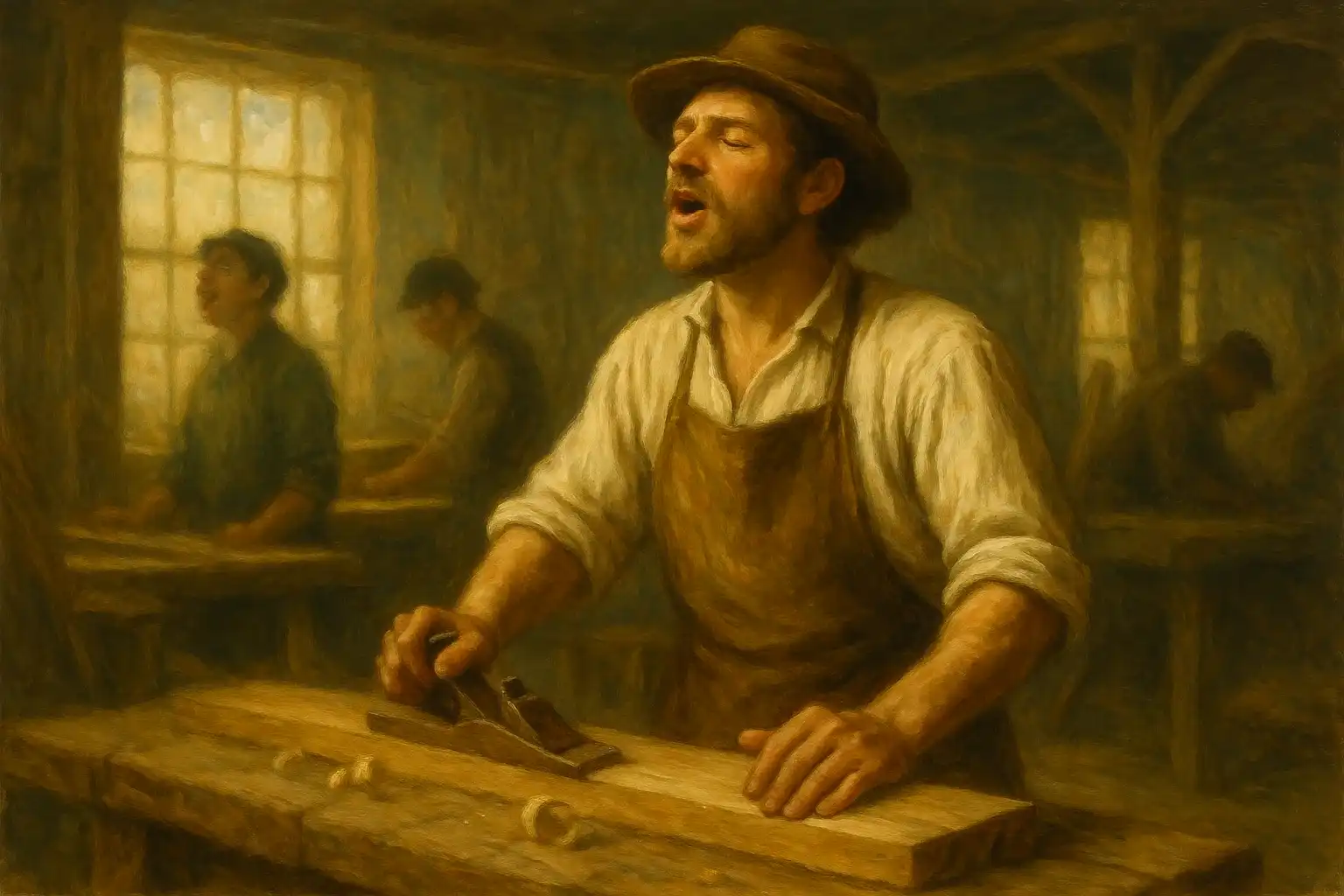
“I Hear America Singing” is one of Whitman’s shortest poems, but it packs his whole democratic vision into just eleven lines. First published in the 1860 edition of Leaves of Grass, it’s basically Whitman listing workers and saying they’re all singing. Not literally singing, obviously. The “song” represents pride, joy, individuality, the sense that every person’s work matters and contributes to something bigger.
What makes it work is the energy. You get mechanics, carpenters, masons, boatmen, mothers, all these ordinary people doing their jobs, and Whitman treats each one like they’re creating music. It’s optimistic in a way that feels almost naive until you remember he wrote this right before the Civil War when the country was about to tear itself apart. Maybe he was trying to remind people what held them together: not politicians or generals, but regular folks doing regular work. The poem shows up constantly in textbooks and anthologies because it’s a perfect introduction to Whitman. Short, clear, and full of that democratic spirit he’s famous for.
Table of Contents:
Full Poem Text
First published in 1860 in Leaves of Grass. This poem is in the public domain in the United States.
I Hear America Singing
by Walt Whitman
I hear America singing, the varied carols I hear,
Those of mechanics, each one singing his as it should be blithe and strong,
The carpenter singing his as he measures his plank or beam,
The mason singing his as he makes ready for work, or leaves off work,
The boatman singing what belongs to him in his boat, the deckhand
singing on the steamboat deck,
The shoemaker singing as he sits on his bench, the hatter singing as
he stands,
The wood-cutter’s song, the ploughboy’s on his way in the morning,
or at noon intermission or at sundown,
The delicious singing of the mother, or of the young wife at work,
or of the girl sewing or washing,
Each singing what belongs to him or her and to none else,
The day what belongs to the day—at night the party of young
fellows, robust, friendly,
Singing with open mouths their strong melodious songs.
Summary and Meaning
The poem opens with Whitman announcing he hears America singing. Not one song, but “varied carols”—lots of different voices. Then he lists them: mechanics, carpenters, masons, boatmen, shoemakers, wood-cutters, ploughboys. Each person is doing their specific job, and that work is their “song.” The carpenter measures wood, the mason prepares for work, the boatman steers his boat. They’re all engaged in their tasks, taking pride in what they do.
Whitman includes women too, which matters. The mother, the young wife, the girl sewing or washing. Their domestic work gets the same treatment as the men’s labor. All these voices are singing “what belongs to him or her and to none else.” Everyone has their own unique contribution, their own note in the national chorus.
The poem shifts at the end to nighttime. Young men gather together, singing with “open mouths” in strong, melodious voices. This collective singing after a day of individual work suggests how democracy functions: everyone does their own thing during the day, contributing their unique skills, then comes together in community at night.
What’s it really mean? Whitman’s saying America’s strength comes from its people, not its leaders or institutions. Every person doing their job well, taking pride in their work, creates the real foundation of the country. The “singing” represents confidence, joy, and the sense that your labor matters. It’s not drudgery; it’s self-expression. And when all these individual songs combine, you get America itself—diverse, energetic, alive.
The democracy here isn’t abstract. It’s concrete, found in daily work. The carpenter’s song is as important as anyone’s. The mother’s is as valuable as the mechanic’s. This is Whitman’s vision: a nation where every person has dignity, where work gives life meaning, and where individual voices create collective harmony.
Themes and Analysis
Dignity of Labor
The whole poem celebrates work. Not the work of kings or generals, but ordinary labor. Carpenters, mechanics, shoemakers—these are the people Whitman honors. Their work isn’t just necessary; it’s beautiful, worthy of being called a song. This was somewhat radical. Most poetry of Whitman’s era focused on refined subjects and elevated language. Whitman said forget that, the real poetry is in a carpenter measuring a beam or a mother at her chores. Work gives people identity and pride. It’s not something you endure to get to “real life”; it IS real life.
Individuality Within Unity
Each person sings “what belongs to him or her and to none else.” Everyone has their unique contribution. The mechanic’s song isn’t the same as the carpenter’s. But all these different songs create one larger American chorus. This is Whitman’s vision of how democracy works: not by making everyone the same, but by letting everyone be themselves while still belonging to the whole. Unity through diversity, not unity through conformity.
Gender Inclusion
Whitman deliberately includes women’s work alongside men’s. The mother, wife, and girl at domestic tasks get their own lines. Their singing is called “delicious,” which is interesting word choice. Delicious suggests pleasure, sweetness, something to be savored. He’s not treating women’s labor as lesser or separate. It’s part of the same song. For the 1860s, this inclusiveness was notable. Most poets ignored women’s work entirely or treated it as too mundane for poetry.
Democratic Vision
This is Whitman’s democracy made simple. No person is above another. The shoemaker on his bench is as worthy as anyone else. The ploughboy walking to his field in the morning contributes just as much as the boatman on his steamboat. Democracy isn’t just about voting or government structure. It’s about recognizing that every person has inherent value, that all work done well deserves respect. The poem makes democracy tangible by grounding it in specific people doing specific jobs.
Joy and Optimism
The tone throughout is upbeat. Words like “blithe,” “strong,” “delicious,” “robust,” “melodious” create this sense of energy and happiness. People aren’t suffering through their work; they’re singing while they do it. This optimism is part of Whitman’s vision. Life doesn’t have to be grim. Work can be joyful. Community can be harmonious. It’s almost startlingly positive, especially considering the poem came out right before the Civil War.
Structure and Form
The poem is only eleven lines, making it one of Whitman’s shortest. But it still uses his trademark free verse style with long, flowing lines and no rhyme scheme. The lack of strict structure mirrors the poem’s content about freedom and individuality. Just as each worker has their own song, the poem has its own organic form rather than following inherited patterns.
The structure is basically one long list. After the opening declaration (“I hear America singing”), Whitman catalogs different workers. This listing technique, which he uses throughout his work, creates abundance and inclusiveness. The more workers he names, the fuller and richer America seems.
Repetition drives the rhythm. The word “singing” appears throughout, anchoring the poem and creating a musical quality through pure repetition rather than rhyme. Almost every line contains “singing” or “song,” which hammers home the central metaphor.
The lines vary in length, some short and others spilling across multiple lines. This variation prevents monotony and gives each worker’s description its own particular rhythm. The carpenter gets one line, the boatman and deckhand share a longer line, the mother/wife/girl get a full line to themselves.
The ending shifts slightly. After listing individual workers, the final lines describe a group singing together at night. This structural choice moves from individual to collective, showing how separate voices combine. It’s a satisfying conclusion that ties all the individual songs into one unified moment.
Historical and Literary Context
Whitman published this in the 1860 edition of Leaves of Grass, his constantly evolving poetry collection. By 1860, he’d already shocked readers with his free verse style and frank subject matter. This poem fit his democratic vision while being more accessible than some of his longer, more challenging work.
The timing matters. 1860 was the year Lincoln was elected, and the country was heading toward civil war. Southern states would start seceding within months. In this context, Whitman’s poem celebrating national unity through ordinary workers feels almost like a prayer or a wish. He’s describing an America that’s starting to fracture but that he hopes can hold together.
The workers he lists reflect mid-19th century America: more industrial than colonial America but not yet fully industrialized like it would become later. Mechanics, carpenters, masons, boatmen, ploughboys—these occupations defined the country’s economy. By making them the subject of poetry, Whitman was claiming American work and American workers as worthy of art.
Literarily, the poem represents American poetry breaking from European traditions. British poetry of this era still used formal structures and elevated language. Whitman wrote in vernacular American English about American subjects in free verse. This was consciously nation-building through literature. He wanted poetry that sounded like America, not like an American imitating British poets.
The poem has been endlessly anthologized and taught, making it one of the most recognizable pieces of American poetry. Its optimism and brevity make it perfect for introducing students to Whitman before hitting them with the longer, more complex poems.
Significance and Impact
This poem distills Whitman’s entire democratic philosophy into eleven lines. It’s become shorthand for his vision of America: diverse, inclusive, built by ordinary people, unified through differences rather than despite them. That makes it culturally significant beyond its literary merit.
The poem influenced how Americans think about work and national identity. The idea that labor—any labor done well—has dignity became part of American mythology. You see echoes in everything from New Deal art celebrating workers to modern political rhetoric about “hardworking Americans.” Whitman helped create that association between work and American identity.
It’s also a gateway drug for Whitman. Teachers assign this poem because it’s short and accessible but still contains his major themes. Students who might bounce off “Song of Myself” can grasp this. It works as an introduction that makes his longer, stranger work feel less intimidating.
The poem demonstrates how form can match content. Free verse for a free people. Long flowing lines for a country expanding westward. No rigid structure for a democracy that values individual expression. This unity of form and meaning influenced generations of poets who wanted their techniques to reinforce their themes.
Its continued relevance comes from the core message remaining true: societies are built by ordinary people doing ordinary work, and that deserves recognition and respect. The specific jobs have changed—fewer carpenters and masons, more coders and nurses—but the principle holds. Everyone’s contribution matters.
Famous Lines and Quotes
“I hear America singing, the varied carols I hear,” establishes the central metaphor immediately. America’s song is plural, diverse, made of many voices.
“Those of mechanics, each one singing his as it should be blithe and strong,” connects physical labor with joy. The word “blithe” is interesting—carefree, cheerful. Work isn’t burden here.
“The carpenter singing his as he measures his plank or beam,” gives us specific physical detail that makes the metaphor concrete. We can visualize the carpenter at work.
“The delicious singing of the mother, or of the young wife at work, or of the girl sewing or washing,” brings women into the song and uses that interesting word “delicious” to describe their contribution.
“Each singing what belongs to him or her and to none else,” captures the balance between individuality and community that defines Whitman’s democratic vision.
“Singing with open mouths their strong melodious songs,” ends the poem with this image of uninhibited, joyful expression. Open mouths suggest freedom, confidence, no holding back.
Conclusion
“I Hear America Singing” captures Whitman’s democratic vision at its most optimistic and accessible. Every person matters. Every job done well contributes to the national song. No one is above anyone else. The carpenter and the mother, the mechanic and the girl sewing, they’re all singing, all essential, all worthy of poetry.
The poem’s simplicity is deceptive. In just eleven lines, Whitman makes an argument about how democracy should work: not through conformity but through each person contributing their unique voice. The strength comes from variety, from letting everyone sing their own song while still creating harmony together. That’s a vision that’s easy to state but incredibly hard to achieve, which maybe explains why the poem still resonates.
What keeps it relevant is how it honors ordinary life. Whitman looked at people doing their jobs and heard music. He found beauty in the everyday, dignity in common labor. That perspective—that regular life and regular work are worthy of attention and celebration—remains powerful. The specific workers may have changed, but the need to recognize everyone’s contribution hasn’t. The song continues, just with different voices.
Frequently Asked Questions About I Hear America Singing by Walt Whitman
What is “I Hear America Singing” really about?
Whitman’s saying America’s real strength comes from ordinary working people. Each person has their own “song”—their unique contribution, their pride in what they do. When all these individual voices combine, that’s what creates the country. It’s democracy in action: not uniformity, but diverse people each doing their thing well and creating something larger together. The mechanic, carpenter, mother, all of them matter equally.
Why does Whitman focus on workers instead of leaders or famous people?
Because his vision of democracy is grounded in everyday life, not political structures or powerful individuals. He believed the real America existed in ordinary people doing ordinary work. By making them the subject of poetry, he’s saying this is where the country’s actual strength and character live. Kings and generals appear in European poetry; Whitman wanted distinctly American subjects, which meant the people building the country with their hands and labor.
What does the “singing” represent?
It’s not literal singing. The “song” is a metaphor for pride, joy, and individuality. When the carpenter “sings,” it means he takes pleasure and satisfaction in his work. The song represents the confidence and dignity people feel when doing something they’re good at. It’s also about identity. Each person’s song “belongs to him or her and to none else,” meaning everyone has their unique contribution that defines who they are.
Why does Whitman include women in the poem?
To show that the American song includes everyone, not just male workers in traditionally masculine jobs. The mother, wife, and girl doing domestic work are as essential as the mechanics and carpenters. Their labor deserves the same recognition. This inclusion was notable for 1860 when most poetry ignored women’s work or treated it as too mundane for art. Whitman insists that all labor, regardless of who performs it, has dignity and value.
What is the poem’s tone?
Overwhelmingly optimistic and energetic. Words like “blithe,” “strong,” “delicious,” “robust,” “melodious” create this upbeat, positive atmosphere. People aren’t suffering; they’re singing. Work isn’t drudgery; it’s joyful. The whole poem radiates confidence in America and its people. This optimism is striking given that Whitman wrote it right before the Civil War. Maybe he was trying to remind people what they had in common before everything fell apart.
How does the poem reflect Whitman’s idea of democracy?
It shows democracy as equality of dignity rather than just political equality. The shoemaker on his bench and the boatman on his steamboat are equally worthy of being in the poem, equally important to America’s song. No job is ranked above another. No person’s contribution is more valuable than anyone else’s. This is democracy lived rather than democracy theorized—the recognition that every person has inherent worth and that society works best when everyone can contribute their unique voice.
Why is this poem still taught and read today?
Because it’s short, clear, and communicates something fundamental about American identity that still resonates. The specific jobs have changed—fewer carpenters and masons now, more tech workers and service industry folks—but the core message holds up: ordinary people doing their work well are what make a society function, and that deserves recognition. Teachers love it because it introduces Whitman without overwhelming students. The optimism and accessibility make it feel timeless even though it’s describing a specific historical moment.
Explore More Whitman
If you enjoyed our analysis, keep exploring Whitman’s works with the following articles: