
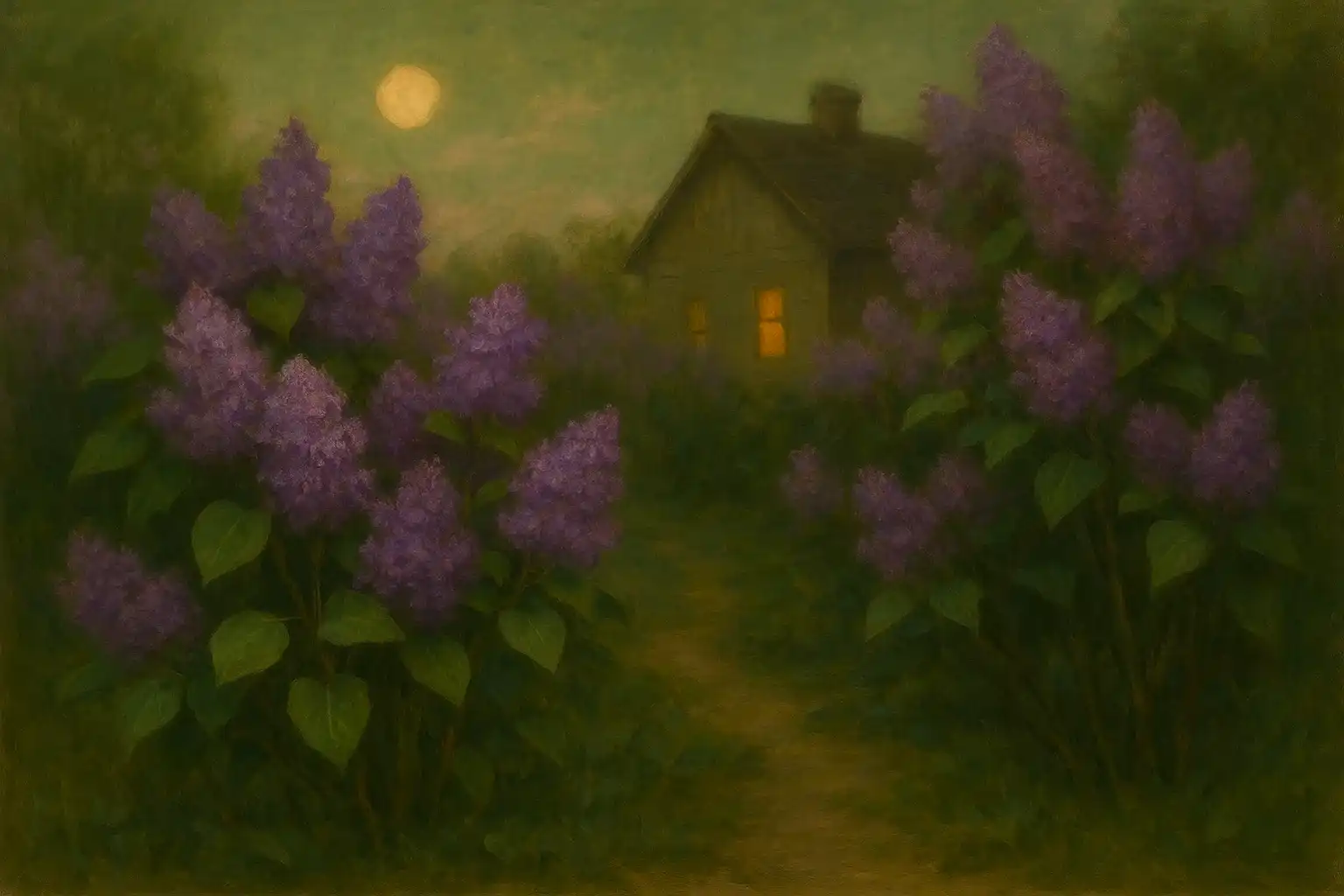
“When Lilacs Last in the Dooryard Bloom’d” is Whitman’s long elegy for Abraham Lincoln, though he never actually says Lincoln’s name. Written in 1865 right after the assassination, this poem processes grief through images from nature: spring lilacs, a falling star, the song of a thrush. Instead of writing a traditional eulogy full of praise and political language, Whitman lets symbols do the work. The result feels more personal and universal at the same time.
This is one of Whitman’s longest poems, and it doesn’t move in a straight line. It circles back on itself, returns to the same images again and again, moves through stages of shock and sorrow and something like acceptance. The lilac keeps blooming, the bird keeps singing, and Whitman weaves those natural rhythms into the experience of mourning. What makes it powerful is how it turns one man’s death into something that speaks to anyone who’s lost someone they cared about. No neat resolution, no easy comfort. Just grief lived through and absorbed into the ongoing cycle of life.
Table of Contents:
Full Poem Text
Due to the length of this poem, we’ve placed the full text on a separate page. This keeps the article readable while still giving you access to the complete work.
Read the full poem here:: When Lilacs Last in the Dooryard Bloom’d by Walt Whitman
Summary and Meaning
The poem opens with three symbols that will run through the entire piece: the blooming lilac, a star that “drooped” in the western sky, and a thrush singing somewhere in the swamp. Whitman says when these appeared together, he mourned, and will mourn “with ever-returning spring.” Right away you know this is about recurring grief, not one-time sorrow.
The star represents Lincoln. It’s fallen from the sky, this bright presence now gone. The lilac stands for memory and renewal. Every spring it blooms again, bringing back the grief but also proving life continues. The thrush sings its “death carol,” giving voice to sorrow itself in a way that words can’t quite capture.
Whitman imagines walking with Lincoln’s coffin as it travels across the country. He pictures placing sprigs of lilac on the coffin, covering it with flowers and leaves. This isn’t the actual historical funeral procession (though that happened), but Whitman’s imaginative participation in national mourning. He’s trying to honor the dead and process his own loss at the same time.
The middle sections get more abstract. Whitman talks about “pictures” rising in his mind. Visions of American landscapes, cities, people grieving. The poem sprawls outward to include the whole country in mourning, not just one person’s experience.
Then comes the bird’s song. The thrush has been present throughout, and now Whitman fully listens to it. The song embraces death, calling it “lovely and soothing.” This is the turning point. Instead of fighting against loss, the poem starts accepting it as part of existence. Death isn’t an interruption; it’s woven into life.
By the end, Whitman achieves something like peace. Not happiness, not forgetting, but a sense that grief and beauty can coexist. The lilac will bloom again next spring. The memory remains. Life continues even after devastating loss.
What’s the deeper meaning? Whitman’s saying mourning isn’t something to escape or solve. You live through it, let it transform you. Nature teaches this. Seasons change, flowers bloom and fade, birds sing even in sorrow. By following those rhythms, we find a way to carry loss without being destroyed by it.
Themes and Analysis
Grief and the Process of Mourning
The poem doesn’t present grief as a single emotion. It’s a process that circles back on itself. Whitman returns to the same images repeatedly, the lilac, star, and thrush appearing again and again. This mirrors how grief actually works. You think you’re past it, then something brings it back. The repetition isn’t monotonous; it’s honest about how mourning functions. You don’t get over loss in a linear way. You spiral around it, finding new angles, slowly absorbing it into your life.
Nature as Teacher and Healer
Whitman turns to the natural world for understanding. The lilac blooms every spring regardless of human pain. The thrush sings its song whether anyone listens or not. The star shines until it doesn’t. These natural rhythms suggest death belongs to a larger cycle. It’s not aberrant or wrong; it’s part of existence. This doesn’t erase the pain, but it provides context. Nature absorbs grief without being diminished by it, which offers a model for how humans might do the same.
Collective vs. Personal Grief
The poem moves between Whitman’s individual sorrow and national mourning. Lincoln’s death affected millions, but Whitman makes it personal by imagining himself placing lilacs on the coffin. He’s one person grieving while also representing everyone grieving. This balance between private and public makes the poem work as both intimate expression and national elegy. Your individual loss matters, but it’s also part of something larger, a shared human experience of grief.
Death as Part of Life
The thrush’s song is crucial here. It calls death “lovely and soothing,” which seems wrong until you sit with it. Whitman isn’t saying death is good. He’s saying it’s inseparable from life. The poem works toward acceptance, not in the sense of being okay with loss, but recognizing that resistance is futile. Death happens. Fighting that fact doesn’t change it. The only way through is through, as they say, and the poem models that journey.
Memory and Renewal
The lilac does double duty. It represents memory because every spring it brings grief back. But it also represents renewal because it keeps blooming despite everything. This captures the paradox of living with loss. You remember, and that memory hurts. But life keeps moving forward, offering beauty even in the midst of pain. Memory doesn’t have to mean stagnation. It can coexist with growth and change.
Structure and Form
This poem is massive, 16 sections spanning over 200 lines. It’s structured more like a journey than an argument. You move through stages with Whitman: initial grief, deepening sorrow, imaginative procession with the coffin, listening to the thrush, arriving at acceptance. But it’s not perfectly linear. The poem circles back, repeats images, wanders into tangents. This structure mirrors how grief actually feels—not organized, not tidy, just moving through it as best you can.
Whitman uses his typical free verse. No rhyme, no regular meter, lines of wildly varying lengths. Some sections have short, punchy lines. Others sprawl across multiple phrases. This flexibility lets him match form to feeling. When grief is sharp and immediate, lines are short. When he’s reflecting or describing landscapes, they stretch out.
The three central symbols (lilac, star, thrush) create unity. They appear repeatedly throughout, like a musical motif returning in different variations. This repetition gives the sprawling poem coherence. No matter how far Whitman wanders, these images pull everything back together.
Section breaks create breathing room. You can pause, process what just happened, then continue. Without those breaks, the poem might feel overwhelming. With them, it becomes manageable, almost like reading in chapters.
The poem also uses apostrophe heavily. Whitman addresses the lilac, the star, the coffin, the thrush, death itself. This creates intimacy. He’s not describing from a distance; he’s talking directly to the subjects of his grief. That directness makes the emotion immediate and raw.
Historical and Literary Context
Whitman wrote this in 1865, immediately after Lincoln’s assassination on April 14. The whole country was in shock. The Civil War had just ended (Lee surrendered April 9), and suddenly the president who’d guided the nation through it was dead. Whitman had seen Lincoln around Washington during the war years and deeply admired him. The assassination hit hard.
Lincoln’s funeral train traveled from Washington D.C. to Springfield, Illinois, stopping in major cities along the way. Millions lined the route to pay respects. Whitman likely witnessed part of this in New York. That experience of collective mourning, the physical journey of the coffin across the landscape, directly influenced the poem’s imagery.
The poem appeared in Sequel to Drum-Taps, a collection of Whitman’s Civil War poetry. That context matters. This wasn’t just mourning one man; it was processing four years of massive national trauma. The war killed over 600,000 Americans. Whitman had volunteered as a nurse, seeing death constantly. This elegy for Lincoln carries all that accumulated grief.
Literarily, the poem breaks from traditional elegy conventions. Classical elegies followed strict forms and moved through specific stages: lament, praise, consolation. Whitman keeps the emotional arc but throws out the formal structure. He uses free verse, American landscape imagery, and symbols from nature rather than classical mythology. It’s a distinctly American elegy for an American president.
The poem influenced later American poets, especially those writing political elegies or grappling with national trauma. You can see its impact in how American poetry deals with public grief, using personal voice to address collective loss.
Significance and Impact
This poem gave Americans a way to grieve Lincoln that felt authentic and capacious. It wasn’t stiff or formal. It wandered, circled, admitted confusion and pain, then found something like peace. That emotional journey resonated with people processing not just Lincoln’s death but the entire Civil War experience.
The poem demonstrated that American poetry could handle massive national subjects without imitating European forms. Whitman created an elegy that felt native to American experience, using American landscapes and vernacular language. This helped establish an American poetic tradition distinct from British models.
From a craft perspective, the poem shows how to sustain a long work through recurring imagery. Those three symbols (lilac, star, thrush) appear throughout, each time adding new layers of meaning. That technique influenced countless later poets working with extended sequences.
The poem remains relevant because it addresses grief honestly. No platitudes, no rush to consolation. Just the raw experience of loss and the slow, messy process of learning to live with it. People still find comfort in that honesty when dealing with their own grief.
It also offers a model for how personal and political can merge in poetry. Whitman makes Lincoln’s death both a national tragedy and an intimate personal loss. That balance is difficult to achieve, but when done well, it speaks to both individual hearts and collective experience.
Famous Lines and Quotes
“When lilacs last in the dooryard bloom’d, / And the great star early droop’d in the western sky in the night, / I mourn’d, and yet shall mourn with ever-returning spring.” The opening establishes the three symbols and the theme of recurring grief tied to natural cycles.
“O western orb, sailing the heaven, / Now I know what you must have meant.” Whitman addresses the fallen star (Lincoln) directly, giving cosmic scale to personal loss.
“Sing on, sing on you gray-brown bird, / Sing from the swamps, the recesses, pour your chant from the bushes.” The thrush becomes a voice for sorrow itself, singing what words can’t express.
“Coffin that passes through lanes and streets, / Through day and night with the great cloud darkening the land.” This grounds the poem in the historical moment of Lincoln’s funeral train crossing America.
“Come lovely and soothing death, / Undulate round the world, serenely arriving, arriving.” From the thrush’s song, this represents the poem’s movement toward accepting death as part of existence.
“Lilac and star and bird twined with the chant of my soul.” Near the end, Whitman unites the three symbols with his own spirit, showing how grief becomes integrated into identity.
Conclusion
“When Lilacs Last in the Dooryard Bloom’d” stands as Whitman’s most profound meditation on loss. Written in the immediate aftermath of Lincoln’s assassination, it transforms personal and national grief into something universal. By using symbols from nature rather than political language, Whitman created an elegy that speaks to anyone who’s experienced devastating loss.
The poem’s power comes from its honesty. Whitman doesn’t rush toward comfort or pretend grief ends cleanly. He shows the circling, repetitive nature of mourning. He lets sorrow breathe, gives it space, follows it through dark places. But he also finds beauty persisting alongside pain. The lilac blooms, the bird sings, life continues. That coexistence of grief and renewal is what makes the poem feel true.
By the end, nothing’s resolved in the sense of being fixed or healed. Lincoln’s still dead. The loss remains. But something has shifted. Whitman has moved through grief and found a way to carry it forward. The natural world taught him how: by absorbing loss without being destroyed, by continuing despite everything. That lesson, embodied in over 200 lines of wandering, beautiful, painful verse, is what keeps people returning to this poem.
Frequently Asked Questions About When Lilacs Last in the Dooryard Bloom’d by Walt Whitman
What is this poem really about?
It’s Whitman grieving Abraham Lincoln’s assassination, though he never mentions Lincoln by name. Instead of writing a traditional political eulogy, he processes the loss through three nature symbols: a blooming lilac (memory and renewal), a fallen star (Lincoln), and a singing thrush (the voice of grief itself). The poem moves through stages of mourning, from initial shock to something like acceptance, showing how grief circles back on itself and how nature’s rhythms can help us absorb devastating loss.
Why doesn’t Whitman name Lincoln directly?
By avoiding Lincoln’s name, Whitman makes the poem universal. If he writes specifically about President Lincoln the politician, the poem stays historically bound. By using symbols, he creates an elegy that speaks to anyone processing loss. The grief becomes both deeply personal and widely applicable. It’s Lincoln, but it’s also your loved one, my loved one, anyone who’s died. That universality is part of why the poem still resonates 150+ years later.
What do the three main symbols mean?
The lilac represents memory and renewal because it blooms every spring, bringing grief back but also proving life continues. The star (the “western orb”) represents Lincoln himself, a bright presence that’s fallen from the sky. The hermit thrush gives voice to sorrow, singing a “death carol” that expresses what words can’t capture. These three images weave throughout the poem, returning again and again, creating unity in a sprawling work.
Why is the poem so long?
Because grief isn’t quick or simple. The length mirrors the actual experience of mourning, which circles back, wanders, takes time. Whitman could have written a short, tight elegy, but that wouldn’t capture what processing major loss actually feels like. You need space to move through different stages, to repeat yourself, to approach the pain from different angles. The poem’s 200+ lines give that space. It’s long because grief is long.
What’s the significance of the thrush’s song?
The thrush sings what Whitman calls a “death carol,” embracing death as “lovely and soothing.” This seems wrong at first, but it’s crucial to the poem’s movement toward acceptance. The bird isn’t saying death is good. It’s saying death is part of existence, inseparable from life. By listening to the thrush, Whitman learns to stop resisting loss and instead absorb it. The song models a different relationship with death, not fighting it but acknowledging it as natural and inevitable.
How does this poem relate to the Civil War?
Lincoln was assassinated just days after the war ended. Whitman had spent years as a volunteer nurse in military hospitals, seeing massive death and suffering. The poem isn’t just about one man’s assassination; it’s processing four years of national trauma. All that accumulated grief gets channeled into mourning Lincoln. The funeral procession Whitman imagines, with the coffin crossing American landscapes, mirrors both the literal funeral train and the country’s need to heal from war.
Why is this poem still important today?
Because it’s honest about grief in a way that remains rare. Whitman doesn’t offer easy comfort or rush to consolation. He shows mourning as messy, circular, painful, and ongoing. But he also shows beauty persisting alongside loss. That combination speaks to anyone dealing with grief, regardless of era. The poem validates the experience of loss while suggesting, through nature’s example, that we can survive it. It’s still one of the best poems about how to carry grief forward without being destroyed by it.
Explore More Whitman
If you enjoyed our analysis, keep exploring Whitman’s works with the following articles: