
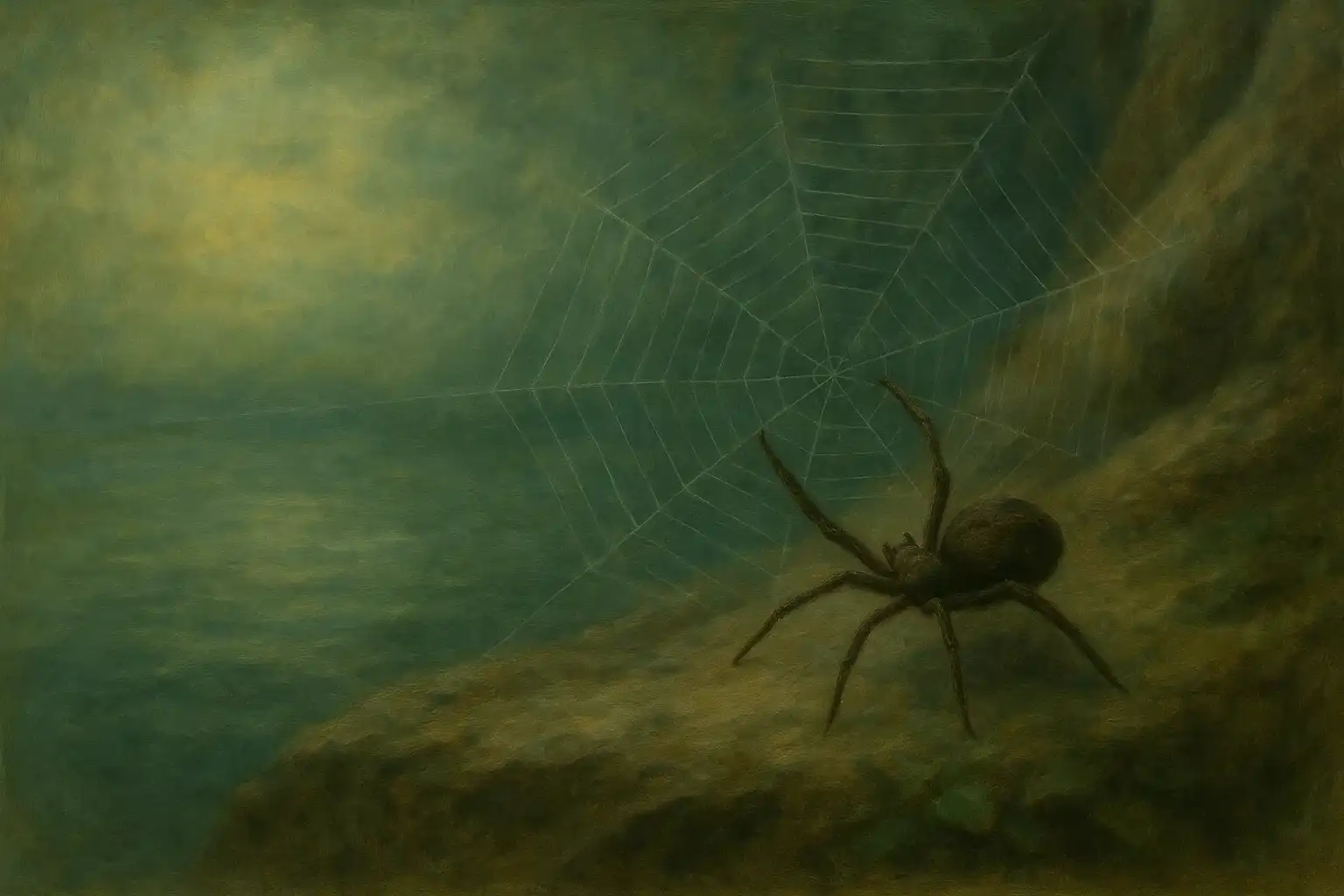
“A Noiseless Patient Spider” is one of Whitman’s shortest poems, but it packs a lot into just ten lines. First published in the 1891 edition of Leaves of Grass (basically the final version he worked on before he died), it takes this tiny moment from nature and turns it into a metaphor for the human soul. The setup is simple: Whitman watches a spider quietly spinning its web, throwing out strand after strand into empty space, hoping something will stick. Then he realizes his own soul does the same thing.
This isn’t typical Whitman. No long catalogues of American workers, no loud democratic celebrations. Just one spider on a rock, working patiently, and Whitman seeing himself in it. The poem works because everyone knows that feeling of reaching out into emptiness, hoping to connect with something or someone, not sure if anything will hold. The spider becomes this perfect symbol for spiritual searching, intellectual curiosity, or just the basic human need to not feel alone in the universe.
Table of Contents:
Full Poem Text
First published in 1891 in Leaves of Grass. This poem is in the public domain in the United States.
A Noiseless Patient Spider
by Walt Whitman
A noiseless patient spider,
I mark’d where on a little promontory it stood isolated,
Mark’d how to explore the vacant vast surrounding,
It launch’d forth filament, filament, filament out of itself,
Ever unreeling them, ever tirelessly speeding them.
And you O my soul where you stand,
Surrounded, detached, in measureless oceans of space,
Ceaselessly musing, venturing, throwing, seeking the spheres to connect them,
Till the bridge you will need be form’d, till the ductile anchor hold,
Till the gossamer thread you fling catch somewhere, O my soul.
Summary and Meaning
First stanza is all about the spider. Whitman notices it standing alone on this little outcrop, surrounded by empty space. The spider starts sending out these silk threads, one after another, letting them drift into the air. “Filament, filament, filament” repeats like you’re watching the action happen in real time. The spider’s just working, patient and tireless, throwing out strand after strand, hoping one will catch on something and give it a place to build its web.
Second stanza flips to Whitman’s soul. He addresses it directly: “And you O my soul.” Turns out the soul is doing exactly what the spider does. It’s surrounded by “measureless oceans of space,” feeling detached and isolated. And what does it do? Keeps reaching out, throwing out thoughts or feelings or whatever souls throw out, trying to find something to connect with. The soul’s looking for a bridge, an anchor, some gossamer thread that will catch somewhere solid.
What’s he really getting at? That connection is hard but necessary. Both the spider and the soul are isolated, surrounded by vast emptiness. Both keep trying anyway, throwing out part of themselves into the void. Most attempts probably fail, drift off into nothing. But they keep going because eventually one thread might hold. That persistence is what matters.
The deeper meaning is about the search for meaning itself. We’re all kind of floating in this huge universe, trying to make sense of things, trying to connect with other people or ideas or something bigger than ourselves. It’s lonely work. Most of what we put out there doesn’t stick. But we keep doing it because what else are we going to do? The alternative is just sitting there isolated forever.
Themes and Analysis
Isolation and the Drive to Connect
Both the spider and the soul start from a place of being alone. The spider’s on a “little promontory,” isolated, surrounded by empty space. The soul is “detached” in “measureless oceans of space.” That’s the starting condition: loneliness, separation. But neither one accepts it passively. They both immediately start trying to bridge that gap. The whole poem is about that drive to connect, the refusal to stay isolated even when isolation is your current reality.
Patience and Persistence
Notice Whitman calls the spider “patient.” It doesn’t throw out one strand and quit when nothing happens. It keeps going. “Ever unreeling them, ever tirelessly speeding them.” That repetition of “ever” emphasizes the endless quality of the effort. The soul gets the same treatment: “ceaselessly musing, venturing, throwing, seeking.” Both spider and soul are defined by their refusal to give up. This is Whitman saying persistence matters more than immediate success.
The Search for Meaning in Vastness
That phrase “measureless oceans of space” does heavy lifting. It’s not just physical space. It’s existential space, the overwhelming sense of how big and empty the universe can feel. The soul is trying to find meaning or purpose in that vastness, throwing out threads of thought, hoping to connect with something real. It’s a fundamentally spiritual struggle dressed up as a nature observation.
Small Actions, Universal Truths
Whitman takes the tiniest possible subject (a spider spinning a web) and makes it speak to massive human concerns (spiritual isolation, the search for meaning, the need for connection). That’s his signature move throughout his career, finding the cosmic in the everyday. But here it’s distilled down to just one spider. The smallness makes it more powerful somehow. You don’t need grand subjects to talk about big truths.
Hope Despite Uncertainty
The poem ends with “Till the gossamer thread you fling catch somewhere, O my soul.” That “till” matters. Not “if,” but “till.” Whitman believes the thread will eventually catch, even if he doesn’t know when or where. That’s hope built into the structure of the sentence. The soul keeps casting out its threads because connection is possible, maybe even inevitable if you persist long enough.
Structure and Form
The poem is only ten lines split into two five-line stanzas. That’s it. Super compact. First stanza describes the spider, second stanza mirrors it with the soul. The parallel structure makes the comparison explicit and unavoidable.
Whitman uses free verse, as always. No rhyme, no regular meter. But there’s rhythm through repetition. “Filament, filament, filament” in the first stanza. “Musing, venturing, throwing, seeking” in the second. These repeated words and sounds create pattern without traditional poetic form.
The line lengths vary. Some are short and punchy. Others stretch across multiple phrases. This flexibility lets Whitman match form to meaning. When describing the spider’s action, lines flow and stretch like the threads being thrown. When stating simple facts, lines tighten.
The shift between stanzas is crucial. First stanza is all observation: “I mark’d,” “Mark’d how.” Whitman’s watching something external. Second stanza turns inward: “And you O my soul.” That pivot from outside to inside, from spider to self, is the poem’s key move. The structure makes the metaphor clear without having to explain it explicitly.
The ending focuses on future possibility. Three lines all start with “Till,” creating this sense of waiting, of effort leading toward eventual connection. It’s structurally optimistic, building toward something even if we don’t see it yet.
Historical and Literary Context
This poem appeared in the 1891-92 edition of Leaves of Grass, which Whitman worked on until very near his death in 1892. He was old, sick, reflecting on his life and work. That context makes the poem hit differently. Someone at the end of their life, still thinking about connection and meaning, still casting out threads hoping they’ll catch somewhere.
The late 1800s were wild for science and philosophy. Darwin had completely changed how people thought about life. Astronomy was revealing how vast the universe actually is. Traditional religious certainty was crumbling for a lot of people. Whitman’s “measureless oceans of space” reflects that new awareness of cosmic scale. The soul searching for connection in infinite space isn’t just metaphor; it’s responding to actual scientific discoveries making the universe feel bigger and more impersonal.
Literarily, the poem shows Whitman’s evolution toward simplicity. His early work sprawls, takes up space, celebrates abundance. Here at the end, he’s more focused, distilled. One spider, one soul, ten lines. The essence of his vision compressed into something tiny but complete.
The poem also reflects Transcendentalist influences that shaped Whitman’s thinking. Emerson and Thoreau saw connections between the natural world and human consciousness, found spiritual lessons in observing nature. Whitman does exactly that here, watching a spider and finding a mirror for the soul.
Significance and Impact
This poem demonstrates how much power brevity can have. Ten lines, one simple comparison, but it captures something fundamental about human experience. You don’t need epic length to hit deep truths. That economy has made it one of Whitman’s most taught and anthologized poems.
The spider metaphor has become culturally embedded. People reference it when talking about creative work, spiritual searching, building relationships, any situation where you’re putting yourself out there repeatedly without knowing if anything will stick. The image is simple enough to remember and flexible enough to apply widely.
The poem influenced how later poets thought about finding the universal in the particular. You can trace a line from this poem through imagist poetry and beyond. The idea that one clear, specific image can carry enormous meaning became central to modern poetry, and Whitman demonstrated it perfectly here.
It remains relevant because the feeling it describes hasn’t changed. We still feel isolated in vast spaces (now often digital spaces as much as physical ones). We still throw out parts of ourselves, hoping to connect. The specific technology might be different, but the fundamental human need is the same.
Famous Lines and Quotes
“A noiseless patient spider,” establishes the whole mood in just four words. Quiet, persistent, small but significant.
“It launch’d forth filament, filament, filament out of itself,” uses that triple repetition to make you feel the repeated action. You can almost see the spider throwing strand after strand.
“Ever unreeling them, ever tirelessly speeding them.” That double “ever” emphasizes the endless, patient nature of the work. No quitting, no giving up.
“And you O my soul where you stand, / Surrounded, detached, in measureless oceans of space,” shifts from spider to soul with direct address. That “O my soul” makes it intimate and personal.
“Till the gossamer thread you fling catch somewhere, O my soul.” The ending line is both uncertain and hopeful. The thread will catch somewhere, but we don’t know where or when. Just that it will.
Conclusion
“A Noiseless Patient Spider” might be tiny, but it captures something huge about being human. We’re all kind of like that spider, standing alone, surrounded by emptiness, throwing out parts of ourselves and hoping something connects. Whether it’s ideas, love, creative work, or just the basic attempt to understand existence, we keep casting out those threads even though most of them drift into nothing.
What makes the poem work is the honesty. Whitman doesn’t pretend connection is easy or guaranteed. The spider is isolated, the soul is detached, the space is measureless. That’s real. But he also doesn’t sink into despair. The spider keeps working, the soul keeps searching, and eventually something will catch. That combination of acknowledging difficulty while maintaining hope is why people keep coming back to this poem.
It’s also just a perfect metaphor. Once you’ve read it, you can’t watch a spider without thinking about souls casting out gossamer threads. That’s the mark of great poetry, when an image gets into your head and changes how you see the world. Whitman did that in ten lines, which is pretty impressive.
Frequently Asked Questions About A Noiseless Patient Spider by Walt Whitman
What is the main message of this poem?
Whitman’s saying the soul works like a spider spinning a web. Both are isolated, surrounded by emptiness, but both keep reaching out, trying to connect with something. The spider throws out silk threads; the soul throws out thoughts, feelings, or spiritual searchings. Most attempts probably fail, but persistence eventually leads to connection. It’s about not giving up even when you feel alone and don’t know if your efforts will matter.
Why did Whitman choose a spider as his metaphor?
Because spiders are small, ordinary, overlooked, but they do this incredibly patient, persistent work. Most people don’t watch spiders closely, which makes the comparison more powerful. Whitman’s showing that even the tiniest creature demonstrates the same drive for connection that humans feel. Also, the spider’s web-spinning is such a perfect visual metaphor for casting out threads into emptiness, hoping something will stick. It’s almost too perfect, which is probably why he grabbed it.
What does “measureless oceans of space” mean?
It’s Whitman’s way of describing the vast emptiness the soul faces. Not literal oceans, but the infinite space of existence, the universe, the unknown. The soul feels small and isolated in this hugeness, surrounded by space it can’t measure or fully comprehend. It’s both physical space (the actual universe) and existential space (the search for meaning in a potentially meaningless cosmos). That phrase captures the overwhelming scale of what we’re up against when we try to find purpose or connection.
Is the poem optimistic or pessimistic?
Both, kind of. Pessimistic in acknowledging isolation and the vastness of the struggle. The spider and soul are both detached, surrounded by emptiness, most of their threads probably don’t connect. That’s bleak. But optimistic in believing persistence works. The poem ends with “Till the gossamer thread you fling catch somewhere,” that “till” suggesting eventual success is coming. Not if, but till. So it’s realistic about difficulty while maintaining hope that effort leads somewhere.
What’s the significance of the poem being so short?
The brevity mirrors the simplicity of the observation. Whitman sees a spider, thinks about his soul, draws the connection. Done. No need to elaborate for pages. The short length also makes the poem memorable and quotable. You can hold the whole thing in your head at once, which gives it more impact. Sometimes Whitman sprawls across hundreds of lines; here he proves he can hit just as hard in ten. The compression makes every word count.
How does this poem fit with Whitman’s other work?
It’s classic Whitman themes (connection, the search for meaning, finding the universal in the particular) but in a quieter register. His big poems like “Song of Myself” celebrate abundance and connection loudly. This poem deals with the same concerns but through silence and smallness. One tiny spider instead of catalogues of American workers. It shows his range, proves he could do intimate and focused as well as epic and sprawling.
Why does the poem still resonate with modern readers?
Because feeling isolated and hoping to connect is timeless. We still cast out threads (now often literally, through social media, emails, texts, creative work) and hope something sticks. The technology changes but the fundamental human experience doesn’t. Also, in an age of information overload and constant connectivity that somehow still feels lonely, a poem about persistent searching for real connection hits hard. We’re all still that patient spider, throwing out strand after strand, hoping one will hold.
Explore More Whitman
If you enjoyed our analysis, keep exploring Whitman’s works with the following articles: