
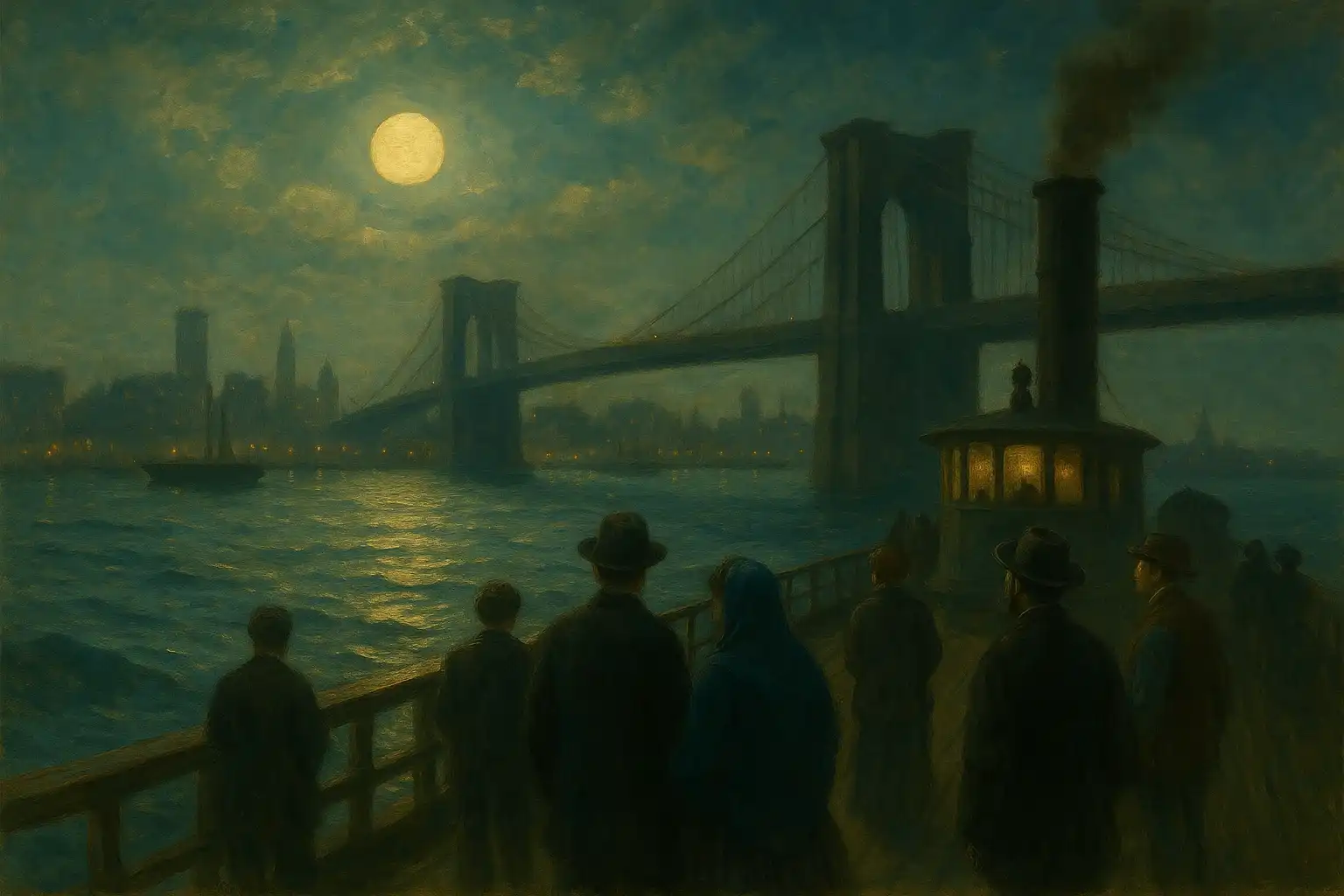
“Crossing Brooklyn Ferry” might be the most intimate conversation Walt Whitman ever had with people he knew he’d never meet. Published in 1856, the poem starts with something completely ordinary: his daily commute across the East River between Brooklyn and Manhattan. But somewhere between boarding the ferry and reaching the other shore, Whitman realizes he’s not just watching water and crowds. He’s witnessing something that will keep happening long after he’s gone, and that realization transforms a routine trip into a meditation on time, connection, and what it means to share the same world with people separated by centuries.
The genius of the poem is how Whitman talks directly to us. Not to “future generations” in some abstract way, but to you, specifically, as if he’s standing right there pointing at the same river you might see today. He insists that the feelings you have when you look at moving water or city lights are the same ones he had in 1856. That directness makes the poem feel alive in a way most 19th-century poetry doesn’t. You’re not reading about his experience. You’re having a shared experience across time.
Table of Contents:
Full Poem Text
Due to the length of this poem, we’ve placed the full text on a separate page. This keeps the article readable while still giving you access to the complete work.
Read the full poem here: Crossing Brooklyn Ferry by Walt Whitman
Summary and Meaning
The poem opens with Whitman on the ferry, noticing everything around him. The flood tide, the seagulls, the way sunlight hits the water, the other passengers, the Manhattan skyline in the distance. Normal commute stuff. But then his mind starts wandering forward. He imagines people fifty years in the future taking the same ferry, seeing the same islands, feeling the same river spray. Then a hundred years. Then further still.
That’s when he starts talking to those future passengers directly. He tells them he knows what they’re seeing because he saw it too. The same sunset colors on the water. The same sense of being part of something larger than yourself. Even the same complicated feelings, the doubts and desires and confusions that come with being human. He’s not just describing a ferry ride anymore. He’s reaching across time to say, “I was here, and I know you’ll be here too, and that connects us.”
The meaning gets deeper as Whitman admits his own flaws. He talks about having been arrogant, lustful, uncertain, all the messy human stuff. But instead of this being confessional poetry about his personal struggles, he’s saying: you’ve felt these things too, haven’t you? Or you will. That shared imperfection is part of what links people across generations. Not just the beautiful sunsets but the complicated inner lives.
By the end, Whitman’s basically declaring that time and distance don’t matter as much as we think. The physical act of crossing the river becomes a symbol for how human experiences cross the boundaries between past, present, and future. Every person who stands on that ferry and watches the water is having a moment that ties them to everyone else who has ever stood there. The ferry ride proves we’re not isolated in our own little time periods. We’re all part of one continuous human experience.
Themes and Analysis
Connection Across Time
This is the heart of the poem. Whitman keeps insisting that future readers will have the same experiences he’s having right now. “Just as you feel when you look on the river and sky, so I felt.” That’s not metaphor or poetic license. He genuinely believes it. The poem works because he’s right. People still take boats across water, still watch light change on waves, still have that feeling of being small and large at the same time. Whitman understood that certain human experiences transcend their historical moment.
The Sacred in the Ordinary
A ferry commute is about as mundane as it gets. Working people going back and forth between Brooklyn and Manhattan, probably tired, maybe bored. But Whitman treats it like it’s sacred. The way he describes the tide and the clouds and the crowds, you’d think he was witnessing something profound. Which is the point. He’s arguing that daily life holds as much meaning as any grand historical event. You don’t need a battlefield or a coronation. You just need to pay attention to what’s in front of you.
Shared Humanity Through Imperfection
Whitman doesn’t present himself as some wise poet who has life figured out. He admits to having struggled with arrogance, with desire, with all sorts of internal conflicts. Then he turns to future readers and says, basically, “You’ve got the same stuff going on, right?” That honesty creates solidarity. We’re not connected just through beautiful moments but through the messy, difficult parts of being human. The poem suggests that recognizing our shared flaws is just as important as recognizing our shared joys.
Breaking the Limits of the Present Moment
Most people are trapped in their own time period. We can’t actually reach backward or forward. But Whitman refuses to accept that limitation. He writes as if the barriers between past, present, and future are permeable. “Closer yet I approach you,” he says, as if he’s somehow moving through time toward us. The poem itself becomes proof that he’s right. Here we are, reading his words, feeling that connection he promised. He found a way to make time collapse.
The River as Symbol
The East River isn’t just scenery. It’s the perfect symbol for what Whitman’s exploring. Water is constantly moving, never the same twice, yet the river itself is always there. That combination of change and permanence mirrors human existence. Individual people come and go, but humanity continues. The tide flows and ebbs, but the pattern repeats. Whitman uses the river to show how something can be both temporary and eternal.
Structure and Form
The poem runs nine sections, though Whitman doesn’t number them in most versions. Each section builds on the previous one, gradually expanding from simple observation to cosmic connection. First section is just Whitman noticing his surroundings. By the middle sections, he’s talking to future readers. By the end, he’s celebrating the eternal nature of these shared experiences.
Whitman uses free verse throughout, no rhyme scheme, no regular meter. But there’s definitely rhythm. He repeats phrases and sentence structures, creating patterns without traditional form. “Flow on, river! flow with the flood-tide, and ebb with the ebb-tide!” That repetition mimics the motion of water, the back-and-forth of the ferry crossing. The form matches the content.
The lines vary wildly in length. Some are short and punchy. Others stretch across multiple thoughts, piling up images and ideas. This flexibility lets Whitman match his rhythm to what he’s describing. When he’s cataloguing sights, the lines sprawl. When he’s making direct statements, they tighten up.
The most striking structural choice is the direct address. Whitman keeps saying “you” and talking to readers as if we’re standing right there with him. That second-person address breaks through the usual poet-reader distance. We’re not observing his experience from outside. We’re included in it. That technique makes the poem feel immediate even though it was written almost 170 years ago.
The repetition of “I too” creates a pattern of identification. “I too walked the streets of Manhattan.” “I too felt the curious abrupt questionings stir within me.” Each repetition reinforces the connection between Whitman and his readers. We’re not separate. We’re versions of the same experience.
Historical and Literary Context
Whitman published “Crossing Brooklyn Ferry” in the 1856 edition of Leaves of Grass, back when he was still expanding and revising the collection with each new printing. At that point, he was living in Brooklyn and taking the ferry regularly. It wasn’t just a poetic subject. It was his actual commute.
The timing matters. This was pre-Brooklyn Bridge, which wouldn’t be completed until 1883. The ferry was the main way to cross the East River, so thousands of people took it daily. It was crowded, loud, a mix of workers and businessmen and families. When Whitman looks around at his fellow passengers, he’s seeing a cross-section of mid-19th-century New York, a city that was growing explosively with immigration and industry.
The poem reflects something happening in American culture at that time. The country was relatively young, and people were thinking about what it meant to build something lasting. Whitman’s obsession with connecting to future generations makes sense in that context. He wanted to create poetry that would matter beyond his own lifetime, that would speak to the America that was still being formed.
Literarily, the poem shows Whitman at his most innovative. Talking directly to future readers wasn’t something poets typically did. You might address posterity in abstract terms, but Whitman gets specific. He describes what future people will see, what they’ll feel, how they’ll be just like him. That boldness, that willingness to collapse time and space in his writing, influenced generations of poets who came after him.
The poem also fits into Transcendentalist ideas that were popular in mid-19th-century America. Emerson and Thoreau wrote about universal connections, about how individual experiences reflect larger truths. Whitman takes that philosophy and applies it to time. If all humans share a connection to the divine or to nature, then why shouldn’t that connection stretch across centuries?
Significance and Impact
This poem basically invented a new way of thinking about time in poetry. Before Whitman, poets might write about historical events or imagine the future, but they didn’t usually talk directly across time the way he does here. He created this intimate conversation with people who wouldn’t exist for decades or centuries. That technique influenced countless later poets who wanted to make their work feel immediate and timeless.
The poem demonstrates how powerful specificity can be. Whitman doesn’t talk about abstract concepts like “eternity” or “human connection.” He talks about the way light looks on water, the sound of the waves, the feeling of standing on a ferry deck. Those specific details make the larger themes hit harder. You believe in the connection he’s describing because you can picture exactly what he’s seeing.
It remains one of the best expressions of how art can defeat time. Whitman wanted to reach across the years and connect with future readers, and it worked. Every time someone reads this poem, they’re having the experience he predicted. They’re looking at his descriptions and recognizing their own feelings. That’s not just poetically effective. It’s actually kind of amazing.
The poem also speaks to something fundamental about being human. We all want to feel connected, to know that our experiences matter, that we’re not just isolated individuals stumbling through our own brief moment in history. Whitman offers proof that we’re not. The same river, the same sunset, the same complicated emotions. That continuity is comforting in a way that still resonates.
Famous Lines and Quotes
“Flood-tide below me! I see you face to face!”
Opens the poem with this immediate, almost aggressive directness. Whitman’s not just observing the river. He’s confronting it, engaging with it as if it’s another person. Sets the tone for everything that follows.
“Others will see the islands large and small; / Fifty years hence, others will see them as they cross.”
Here’s where Whitman starts explicitly talking about future passengers. That “fifty years hence” anchors the idea in something specific. He’s not being vague. He’s imagining actual people in 1906 taking the same trip.
“It avails not, time nor place—distance avails not.”
The thesis statement of the poem, basically. Time and distance don’t matter when it comes to shared human experience. Those barriers we think are solid can actually be crossed through attention and awareness.
“Just as you feel when you look on the river and sky, so I felt.”
Pure Whitman. Direct address, immediate connection, insisting on the continuity of feeling across time. No fancy metaphors, just a simple declaration that he knows what you’re feeling because he felt it too.
“Closer yet I approach you.”
A brief line that somehow captures the whole poem’s project. Whitman’s moving through time toward us, getting closer with every word, until the distance between 1856 and now feels like nothing.
“What is more subtle than this which ties me to the woman or man that looks in my face? / Which fuses me into you now, and pours my meaning into you?”
Whitman wondering about the mystery of connection. How does reading a poem create such an intimate bond between people who never met? He doesn’t answer the question. He just marvels at it.
Conclusion
“Crossing Brooklyn Ferry” proves that the most ordinary moments can carry extraordinary meaning. Whitman took his daily commute and turned it into evidence that time isn’t as linear as we think, that people separated by centuries can share the same feelings, that human experience creates continuity even when everything else changes. The ferry itself is long gone, replaced by bridges and tunnels, but the poem’s central insight remains true. We’re all looking at the same world, feeling variations on the same emotions, connected by the simple fact of being human.
What makes the poem work is Whitman’s voice. He doesn’t lecture or explain. He just talks to you like he knows you’ll understand because you’ve had similar experiences. That confidence is justified. The poem has been connecting with readers for almost 170 years now, and it shows no signs of losing its power.
If you’re standing by water sometime, watching light change on the surface, thinking about time and continuity and your place in the world, congratulations. You’re having the exact experience Whitman predicted you’d have. That’s the poem working exactly as intended.
Frequently Asked Questions About Crossing Brooklyn Ferry
What is Crossing Brooklyn Ferry really about?
On the surface, it’s Whitman describing his ferry commute between Brooklyn and Manhattan. But the real subject is how shared experiences connect people across time. Whitman realizes that future passengers will see the same river and skyline he’s seeing, which means they’ll have a direct connection to him even though they live in different centuries. The poem’s about overcoming isolation, proving that we’re all part of one continuous human story rather than just isolated individuals trapped in our own time periods.
Why does Whitman talk directly to future readers?
Because he wants to collapse the distance between his time and ours. Most poets write for their contemporary audience and hope future readers will appreciate it too. Whitman flips that. He’s explicitly writing for people who won’t be born until after he’s dead. That direct address, the constant “you” and “I,” makes the connection feel personal and immediate. It’s his way of proving that poetry can bridge time, that words on a page can create real intimacy across centuries.
What does the ferry ride symbolize?
The ferry represents transition and crossing boundaries. Obviously, it’s crossing physical water between Brooklyn and Manhattan. But symbolically, it’s crossing between past and future, between individual experience and collective humanity. The movement of the boat mirrors the flow of time. People get on, cross, get off, while the ferry itself keeps making the same trip over and over. That repetition with variation is exactly what Whitman sees in human existence.
How does this poem relate to Whitman’s other work?
It’s classic Whitman in its celebration of connection and democracy of experience. Like “Song of Myself,” it’s about breaking down barriers between people. But it’s more focused than his sprawling catalogues. Instead of listing hundreds of American types, he concentrates on one specific moment and mines it for universal meaning. The poem shows he could be just as powerful in concentrated form as in his longer, more expansive works.
Why does Whitman admit his flaws in the poem?
Because he wants to connect with readers through honesty, not perfection. If he presented himself as some enlightened poet who has everything figured out, readers might admire him but wouldn’t identify with him. By admitting he’s struggled with arrogance, desire, confusion, all the normal human stuff, he creates solidarity. The message is: we’re connected not just through beautiful moments but through our shared imperfections. That honesty makes the poem more powerful.
What’s significant about the historical setting?
Whitman’s writing during massive growth in New York. The city was exploding with immigrants, industry was booming, American identity was still being formed. The ferry was one of the main arteries of daily life before the Brooklyn Bridge existed. So when Whitman talks about thousands of people crossing every day, that’s literal. He’s seeing democracy in action, all these different people sharing the same space and experience. That democratic mixing matters to his vision of shared humanity.
Does the poem still work if you’ve never taken a ferry?
Absolutely. The ferry’s just the vehicle, so to speak. The real subject is any shared experience that connects people across time. Watching a sunset, walking through a city, looking at stars, any moment where you realize people before you had this exact experience and people after you will too. The poem’s describing a universal human awareness. The ferry just happens to be Whitman’s specific example.
Explore More Whitman
If you enjoyed our analysis, keep exploring Whitman’s works with the following articles: