
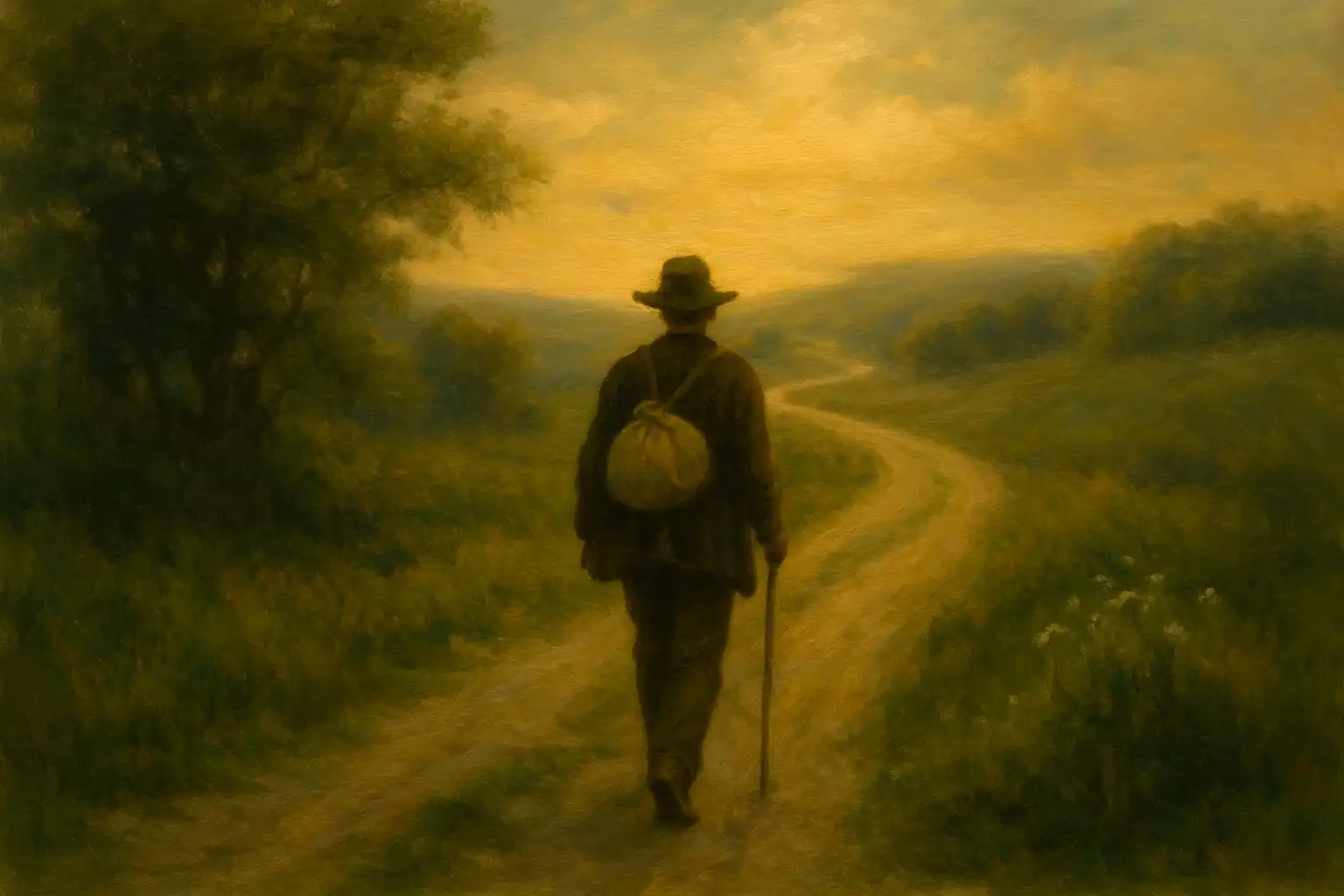
“Song of the Open Road” showed up in the 1856 edition of Leaves of Grass, and it’s Whitman at his most optimistic and inviting. The setup sounds simple: he’s taking a walk down an open road, feeling good about it. But Whitman being Whitman, a walk never stays just a walk. Within a few lines, that road becomes a symbol for freedom, possibility, democracy, and basically every hopeful idea he has about what life could be if we’d just step forward and embrace it.
What makes the poem work is how it pulls you in. Whitman doesn’t present this as his private adventure. He keeps turning around to see if you’re coming with him, inviting you to leave behind whatever’s holding you back and just start walking. The road is wide enough for everyone, and he genuinely means everyone. That inclusive energy, that sense of “come on, let’s do this together,” gives the poem its momentum. It’s part travel narrative, part philosophical manifesto, part pep talk for anyone who’s ever felt stuck and needed permission to just go.
Table of Contents:
Full Poem Text
Due to the length of this poem, we’ve placed the full text on a separate page. This keeps the article readable while still giving you access to the complete work.
Read the full poem here: Song of the Open Road by Walt Whitman
Summary and Meaning
The poem opens with Whitman setting out on a walk, feeling healthy and free, the whole world stretched out in front of him. Right away, the road becomes more than just a physical path. It’s a symbol for life, for choice, for the freedom to determine your own direction. That brown path leading wherever he chooses isn’t really about picking a destination. It’s about having the power to choose in the first place.
As he walks, Whitman keeps calling out to others. He wants company. He invites friends, strangers, future readers, basically anyone willing to step onto the road with him. That constant invitation is central to what the poem means. This isn’t one man’s solitary journey. It’s a collective vision of freedom where everyone gets to participate. The road belongs to all of us, not just the privileged few.
There’s also this strong thread about letting go. Whitman urges readers to drop their baggage, literal and metaphorical. Stop carrying regrets, possessions, fears, whatever weighs you down. The road demands lightness. You can’t walk freely if you’re hauling your whole past behind you. That’s both practical advice and spiritual guidance.
The meaning gets more complex when Whitman talks about what the road actually offers. He’s honest that it’s risky. You’re leaving behind safety and certainty. The destination is unknown. You might fail or get lost. But he insists that’s exactly the point. Real living happens in motion, in the act of walking forward without guarantees. Staying put might be safer, but it’s not actually living.
By the end, the poem has become a full philosophy of life. The road represents the journey itself as the destination. Forget about arriving somewhere. Focus on the walking, the companionship, the continuous forward motion. That’s where meaning lives. It’s an optimistic vision, maybe even naive by some standards, but Whitman commits to it completely.
Themes and Analysis
Freedom as Movement
The central theme is freedom, but Whitman defines it through action rather than abstract principle. Freedom means being able to walk down a road with nothing blocking your path. It means choosing your direction. It means moving at your own pace. The poem treats physical movement as both literal and symbolic. Every step forward is an assertion of liberty. Standing still, staying in one place, accepting limits on where you can go, that’s the opposite of freedom. The open road is free because it keeps extending, always offering another mile.
Democratic Inclusion
Whitman can’t stop inviting people to join him. “You road I travel,” “Camerado, I give you my hand,” “Will you come travel with me?” The poem is packed with these direct addresses. He’s not interested in an exclusive journey reserved for enlightened souls or adventurous types. The road is for everyone. Rich, poor, educated, illiterate, young, old, it doesn’t matter. That democratic spirit reflects Whitman’s larger vision of America as a place where everyone belongs. The road becomes a metaphor for the country itself, wide and welcoming.
Risk and Uncertainty
Whitman doesn’t pretend the road is all sunshine and easy walking. He acknowledges the fear that comes with leaving safety behind. You’re giving up comfort, predictability, the known world. The destination is uncertain. You might encounter hardship. But the poem insists this risk is necessary. Playing it safe means missing out on life. The uncertainty is part of what makes the journey meaningful. If you knew exactly where you’d end up, walking there would lose its power. The not-knowing is essential.
Spiritual Discovery
There’s a spiritual dimension running through the whole poem. Whitman suggests that the road offers more than physical travel. It’s a path toward self-knowledge, toward understanding your place in the universe. He talks about the “unseen” that exists alongside the visible road. That suggests the journey is as much internal as external. Walking changes you. The road teaches lessons that staying home never could. It’s not just about seeing new places but becoming a different person through movement.
The Journey Over the Destination
This might be the most important theme. Whitman keeps emphasizing the act of traveling rather than arriving anywhere. The road itself is the goal. That flips normal thinking, where journeys are just the means to reach destinations that matter. Whitman says no, the walking is what matters. The continuous forward motion, the companionship along the way, the daily experience of moving through the world, that’s where life’s meaning lives. Destinations are arbitrary. The road is eternal.
Structure and Form
The poem runs fifteen sections, though different editions sometimes number them differently. Each section builds on the previous one, gradually expanding from Whitman’s personal walk to a universal vision of human possibility. Early sections focus on the immediate experience of being on the road. Later sections zoom out to philosophical reflections on what the road means.
Whitman uses free verse throughout, no rhyme, no regular meter. The lines vary wildly in length. Some are short and punchy. Others roll on for multiple phrases, building momentum through accumulation. That flexibility matches the subject perfectly. A strict form would feel confining. The open form mirrors the open road.
The repetition creates rhythm without traditional poetic structure. Whitman keeps circling back to certain phrases and ideas. “The open road,” “You road,” “Camerado,” these terms appear again and again, creating a sense of continuity. The repetition also mimics the experience of walking, where landscape repeats with variation. Same basic activity, different scenery.
The direct address to readers is constant. “You” appears throughout, making the poem feel like a conversation. Whitman’s not lecturing from a distance. He’s walking beside you, talking as he goes, occasionally turning to make sure you’re still there. That second-person address breaks down the usual separation between poet and reader. We’re not observing his journey. We’re included in it.
The catalogue technique shows up too, classic Whitman. He lists types of people, kinds of experiences, varieties of landscape. These catalogues create a sense of abundance. The road contains multitudes. It’s not one narrow path but an infinite variety of possible routes, all equally valid. The form itself embodies democratic inclusion.
Historical and Literary Context
“Song of the Open Road” appeared in the 1856 edition of Leaves of Grass, still early in Whitman’s career. He was working out what his poetry would sound like, how far he could push free verse, whether American readers would accept his radical style. The poem shows him getting bolder, more confident in his vision.
The timing is significant. The 1850s were brutal years in American history. Slavery was tearing the country apart. Political compromise was failing. Violence was breaking out in Kansas. The nation was headed toward civil war. Against that backdrop, Whitman’s vision of an open road welcoming everyone reads like wishful thinking or deliberate resistance. He was insisting on a version of America that didn’t actually exist but that he believed should exist.
The era was also defined by movement. Westward expansion was accelerating. Railroads were connecting distant regions. Immigrants were arriving in huge numbers. People were constantly on the move, seeking opportunity, escaping poverty, claiming land. The open road wasn’t just metaphor. It was the literal experience of millions of Americans. Whitman took that mass migration and gave it spiritual significance.
Literarily, the poem breaks from European tradition completely. No sonnets, no ballads, no inherited forms. Whitman invented his own structure, or lack of structure. That formal freedom matched his democratic politics. If poetry was going to speak for everyone, it couldn’t be locked into aristocratic forms. The verse had to be as open as the road itself.
The poem also connects to Transcendentalist ideas popular in mid-19th-century America. Emerson wrote about self-reliance and the importance of trusting your own path. Thoreau walked through the woods looking for spiritual truth. Whitman took those ideas and made them more physical, more democratic, more optimistic. The road wasn’t just for philosophers. It was for everyone.
Significance and Impact
This poem basically created a template for American optimism. The idea of hitting the road, leaving everything behind, starting fresh, that’s become a fundamental part of American mythology. You can trace a line from this poem through Beat poetry, through Jack Kerouac’s On the Road, through countless road trip narratives. Whitman established the pattern.
The poem demonstrates how personal experience can carry universal meaning. Whitman starts with his own walk but transforms it into something everyone can relate to. That move from individual to collective became central to modern poetry. You take your specific experience and find the larger human truth in it.
It remains one of the most quoted Whitman poems for a reason. Those lines about the open road, about healthy and free, about choosing your own path, they capture something people still want to believe. Even when life feels constrained and limited, the poem offers this vision of radical freedom available to anyone willing to take the first step.
The poem also matters as a counter to cynicism. Whitman’s optimism can seem naive, especially given the brutal realities of his time. But the poem insists that hope is valid, that believing in possibility is worthwhile. That message resonates whenever things feel dark. The road is still there. You can still walk it. That simple faith in forward motion offers real comfort.
Famous Lines and Quotes
“Afoot and light-hearted I take to the open road, / Healthy, free, the world before me.”
The opening sets the tone perfectly. Whitman steps out with energy and joy. That “light-hearted” matters. This isn’t grim determination. It’s cheerful adventure. The whole world stretching out before him captures the sense of possibility.
“The long brown path before me leading wherever I choose.”
Simple image, huge meaning. The path leads wherever he chooses, not to some predetermined destination. That puts him in control. The road serves his freedom rather than directing it. The brown color grounds it in reality. This is an actual dirt path, not some abstract concept.
“Henceforth I ask not good-fortune, I myself am good-fortune.”
Whitman claiming power over his own life. He’s not waiting for luck or circumstance to improve things. He declares himself the source of good fortune. That confidence, maybe even arrogance, is quintessential Whitman. You create your own destiny.
“You road I enter upon and look around, I believe you are not all that is here, / I believe that much unseen is also here.”
Here’s where the spiritual dimension emerges. The road carries more than what’s visible. There’s unseen depth, hidden meaning, spiritual presence. The journey is physical but also metaphysical. Walking changes you in ways you can’t predict or measure.
“Camerado, I give you my hand! / I give you my love more precious than money.”
Classic Whitman, offering companionship and love freely. “Camerado” is his term for comrade, friend, fellow traveler. The hand extended is both literal and symbolic. He’s creating bonds across distance and difference.
“Will you give me yourself? will you come travel with me? / Shall we stick by each other as long as we live?”
The ending turns into a direct proposal. Whitman’s asking for commitment, for partnership. The poem becomes a marriage proposal to the reader, basically. That intimacy and directness make the invitation impossible to ignore.
Conclusion
“Song of the Open Road” captures everything Whitman believed about freedom, democracy, and human possibility. What starts as a simple walk becomes a vision of how life should be lived: openly, bravely, in motion. The road stretches forward, wide enough for everyone, offering constant renewal to anyone willing to step onto it.
The poem’s lasting power comes from that combination of specificity and universality. Whitman describes an actual road, gives us dirt and horizon and footsteps. But he also transforms it into something larger, a symbol for life itself. Every detail is grounded and real while also pointing toward something transcendent.
What might matter most is the invitation. Whitman doesn’t present himself as a lone adventurer while we watch from the sidelines. He turns around constantly, checking if we’re coming, offering his hand, insisting we join him. The road is collective. Freedom is shared. That generous, inclusive spirit makes the poem feel as relevant now as it did in 1856. The road is still there. The invitation still stands. We can still take that first step.
Frequently Asked Questions About Song of the Open Road
What is Song of the Open Road actually about?
On the surface, Whitman’s taking a walk and enjoying it. But the road quickly becomes symbolic. It represents freedom, choice, possibility, life itself. The poem is really about having the courage to embrace uncertainty, to leave behind safety and comfort, to move forward without knowing exactly where you’ll end up. It’s also about companionship, about sharing the journey with others. The physical road is just the starting point for a much larger vision of how humans should live.
Why does Whitman keep inviting people to join him?
Because his vision of freedom is collective, not individual. He doesn’t want to walk alone. The road only fulfills its promise when it’s shared. That reflects his democratic politics. Freedom isn’t something one person experiences in isolation. It’s something we create together. Every invitation, every “come with me,” reinforces that inclusive vision. The poem insists that we’re all entitled to walk the road, that it belongs to everyone equally.
Is the poem realistic or naive?
Bit of both. Whitman acknowledges the risks and uncertainties of the road. He knows leaving safety behind is scary. But his fundamental optimism, his belief that the journey will be worthwhile, can seem naive. Real life is harder than his vision suggests. Not everyone can just drop everything and walk away. Still, the poem’s value isn’t in being realistic. It’s in articulating a hope, a possibility, a vision worth pursuing even if we can’t fully achieve it.
What does the “open” in open road mean?
Open means unobstructed, available to everyone, stretching forward without end. It’s the opposite of closed, blocked, limited. The road is open because no barriers prevent you from stepping onto it. No gatekeepers decide who’s allowed. It extends as far as you want to walk. That openness is physical but also political and spiritual. It represents a world without artificial constraints, where people are free to determine their own paths.
How does this poem connect to American culture?
It basically defined a major strand of American mythology. The idea of hitting the road to find freedom, starting over, leaving the past behind, that’s deeply embedded in American culture. From westward expansion to Beat poetry to road trip movies, this pattern keeps appearing. Whitman didn’t invent the idea, but he gave it its most powerful poetic expression. The poem articulates something many Americans want to believe about their country: that it offers unlimited possibility to anyone willing to pursue it.
Why does the journey matter more than the destination?
Because Whitman sees life as process rather than achievement. If you’re only focused on arriving somewhere, you miss the actual experience of living. The daily act of moving forward, of being on the road, of encountering new things, that’s where meaning lives. Destinations are arbitrary stopping points. The road itself is eternal. This philosophy challenges conventional thinking about goals and success. It says the how matters more than the where.
Does the poem still resonate with modern readers?
Absolutely. Maybe even more now. In a world that often feels closed and limited, where opportunities seem scarce and freedom feels constrained, Whitman’s vision of an open road welcoming everyone offers genuine hope. The specific details have changed, but the fundamental desire for freedom, for possibility, for the chance to determine your own path, that’s timeless. Every generation needs permission to step onto the road. The poem keeps giving it.
Explore More Whitman
If you enjoyed our analysis, keep exploring Whitman’s works with the following articles: