
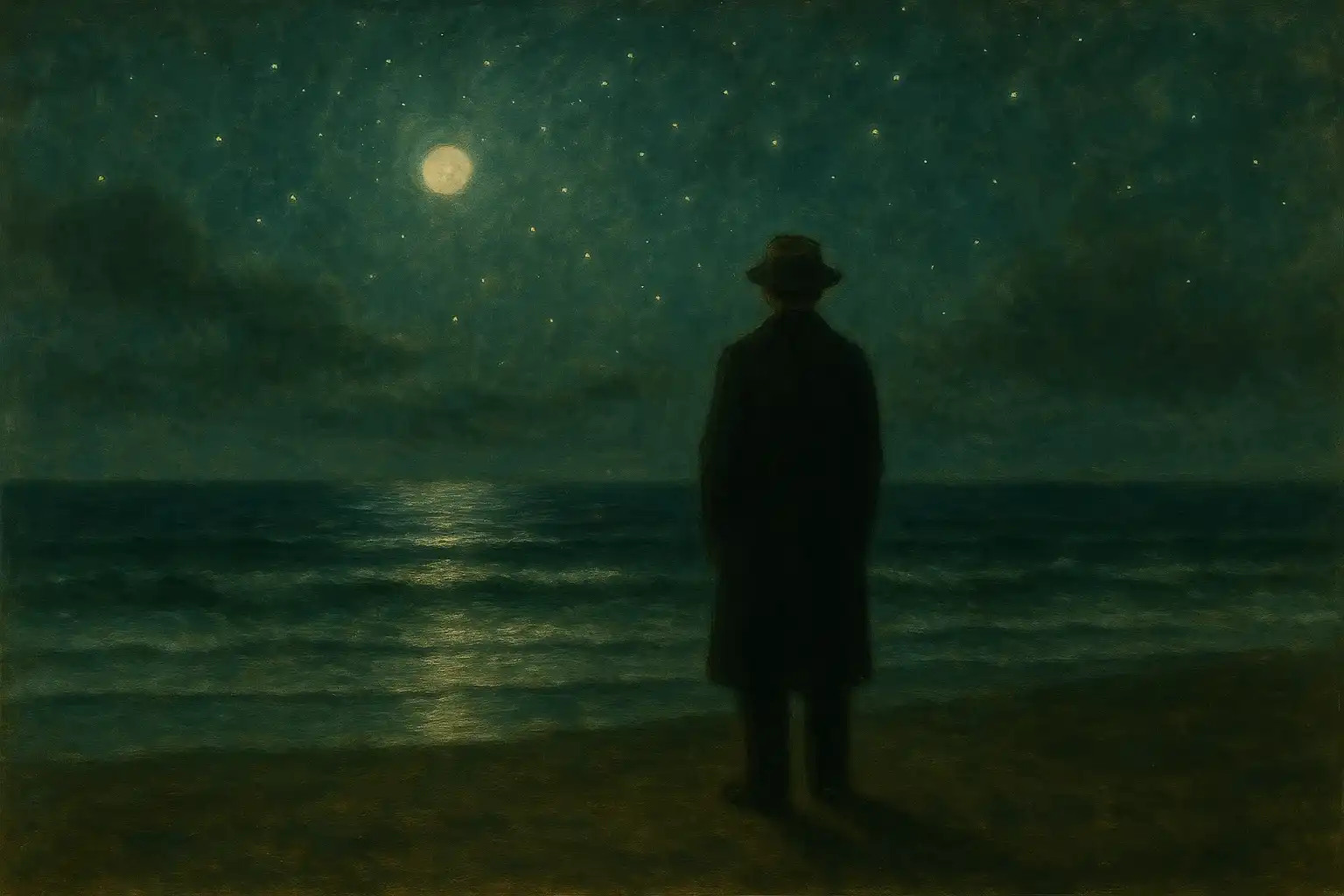
“On the Beach at Night Alone” showed up in the 1867 edition of Leaves of Grass, and it’s one of Whitman’s quieter poems. Not quiet as in boring, but quiet as in contemplative, almost meditative. The setup is straightforward enough: Whitman’s standing alone on a beach at night, listening to the waves, looking at the stars. Simple moment, right? But then his mind takes off, and what starts as solitude turns into this huge cosmic vision about how everything in the universe connects.
This isn’t typical Whitman energy. Usually he’s loud, piling up lists of people and places, celebrating everything with this overwhelming enthusiasm. Here he’s standing still, thinking, feeling small under the night sky. And from that stillness comes this realization that even though he’s physically alone, he’s part of something massive. Every person who ever lived, every star, every particle of matter, all tied together. It’s intimate and cosmic at once, which is probably why it sticks with you even though it’s pretty short.
Table of Contents:
Full Poem Text
First published in 1867 in Leaves of Grass. This poem is in the public domain in the United States.
On the Beach at Night Alone
by Walt Whitman
On the beach at night alone,
As the old mother sways her to and fro singing her husky song,
As I watch the bright stars shining, I think a thought of the clef
of the universes and of the future.
A vast similitude interlocks all,
All spheres, grown, ungrown, small, large, suns, moons, planets,
All distances of place however wide,
All distances of time, all inanimate forms,
All souls, all living bodies though they be ever so different, or in
different worlds,
All gaseous, watery, vegetable, mineral processes, the fishes, the brutes,
All nations, colors, barbarisms, civilizations, languages,
All identities that have existed or may exist on this globe, or any globe,
All lives and deaths, all of the past, present, future,
This vast similitude spans them, and always has spann’d,
And shall forever span them and compactly hold and enclose them.
Summary and Meaning
The poem opens with Whitman alone on a beach at night. He’s listening to the ocean, which he personifies as an “old mother” singing her “husky song.” The waves rock back and forth like something ancient and maternal but also rough, not soft or gentle. He’s watching the stars, and from that simple scene, his mind starts wandering to bigger questions. He thinks about “the clef of the universes,” which is his way of describing the key or code that holds everything together.
Then the poem explodes into this massive catalogue. Whitman lists everything he can think of: spheres, suns, moons, planets, all distances of space and time, souls, living bodies, processes of nature, fish, animals, nations, civilizations, languages. Pretty much everything. He’s saying all of it connects through this “vast similitude,” this enormous pattern that links everything together. Nothing exists in isolation. Every particle, every being, every moment in time is part of one unified whole.
The ending hammers home the permanence of this connection. This unity isn’t new or temporary. It “always has spann’d” everything, and it “shall forever span them.” Past, present, future, all held together in this cosmic embrace. The poem moves from one man alone on a beach to literally everything that exists or ever existed, all tied together.
What’s he really saying? That solitude is an illusion. You can be physically alone, but you’re never truly isolated because you’re part of this massive interconnected universe. Every breath you take, every thought you think, connects you to stars and oceans and people across time and space. It’s Whitman’s version of cosmic consciousness, the idea that separation is surface level and connection is fundamental.
Themes and Analysis
Universal Connection
This is the whole point. Whitman starts alone but immediately realizes he’s not separate from anything. That “vast similitude” he describes isn’t abstract philosophy; it’s something he feels while looking at the stars. Everything interlocks: planets, people, processes, past, present, future. There’s no hierarchy here, which is interesting. A rock and a person and a star are all equally part of the pattern. This radical equality and interconnection is classic Whitman, taking his democratic vision to a cosmic level.
Solitude and Belonging
The poem plays with this paradox beautifully. The title says “alone,” and Whitman is physically by himself. But the realization that comes from that solitude? That he’s never really alone. He’s part of everything. This isn’t solving loneliness by finding company; it’s reframing loneliness as impossible because separation doesn’t actually exist at a fundamental level. You can feel alone, but you’re always connected at a deeper level. That’s both comforting and kind of overwhelming when you think about it.
Time and Eternity
Whitman doesn’t just connect things across space. He connects them across time too. “All lives and deaths, all of the past, present, future” are part of the same web. This means the universe isn’t just big; it’s eternal. The unity he’s describing always existed and always will exist. Death doesn’t break the connection. Distance in time works like distance in space: it doesn’t really matter at the level of fundamental unity. This is Whitman’s way of dealing with mortality and impermanence.
Nature as Teacher
The ocean and stars trigger this realization. Nature isn’t just scenery; it’s a doorway to understanding. Standing on the beach at night creates the conditions for cosmic insight. The “old mother” ocean with her rough, eternal song reminds Whitman that he’s part of something ancient and ongoing. The stars show the vastness of space and time. Without those natural prompts, would he have this realization? Probably not. Nature teaches what no book or lecture can.
The Catalogue as Universe
Whitman’s listing technique reaches its peak here. He doesn’t just name a few things; he tries to name everything. Suns, moons, planets, souls, bodies, processes, fish, animals, nations, languages, identities on this globe or any globe. The list becomes almost hypnotic, overwhelming you with the sheer scope of existence. And by including “all” so many times, he’s making the point that literally nothing is excluded from this unity. The form mirrors the content: an expansive list for an expansive vision.
Structure and Form
The poem is relatively short, maybe 15 lines depending on how you count them. It’s structured in two movements. First three lines set the scene: beach, night, ocean, stars, the speaker beginning to think. Then the rest of the poem is one long vision of unity, with that massive catalogue of everything that exists.
Whitman uses his free verse style, no rhyme, no regular meter. Lines vary wildly in length. Some are short and simple (“On the beach at night alone,”), others sprawl across multiple phrases. This variation in line length creates rhythm through repetition rather than meter. The word “all” appears constantly, anchoring the vision of totality.
The structure moves from particular to universal. We start with one specific person in one specific place: Whitman on a beach. Then we zoom out to include planets, then souls, then time itself, until literally everything is included. It’s like a camera pulling back from one figure to reveal the entire cosmos. That movement from small to infinite is the poem’s journey.
The repetition of “all” creates incantatory quality. “All spheres… All distances… All souls… All nations… All lives and deaths…” It’s like Whitman’s chanting, trying to name everything that exists. The repetition becomes meditative, almost hypnotic. You stop analyzing and just let the vastness wash over you.
The ending loops back to the beginning. We started with “alone” and we end with everything “compactly hold and enclose.” The loneliness at the start gets answered by the encompassing unity at the end. It’s a satisfying structural arc.
Historical and Literary Context
Whitman published this in 1867, just after the Civil War ended. He’d spent years as a volunteer nurse in military hospitals, watching young men die, dealing with massive trauma and loss. That context makes the poem read differently, doesn’t it? Someone who’d seen that much death and suffering looking for cosmic connection and meaning makes sense. The poem isn’t escaping reality; it’s trying to find a framework where all that pain fits into something larger.
The late 1860s were intense for American thought. Darwin’s Origin of Species came out in 1859, and debates about humanity’s place in the universe were everywhere. Science was revealing how vast space and time actually are, which could feel either exciting or terrifying. Whitman’s responding to that with his own vision. Not scientific, but spiritual and emotional. He’s saying yeah, the universe is enormous, but that enormity includes us. We’re not separate from it.
Literarily, the poem shows Whitman’s evolution. His early work was often loud, exuberant, confident. By 1867, he’s quieter, more contemplative. The Civil War changed him, aging him, giving him perspective on suffering and mortality. This poem reflects that maturity. It’s not naive optimism; it’s hard-won wisdom about connection in the face of loss.
The poem also fits into Transcendentalist ideas that were floating around American culture. Emerson and Thoreau had been writing about the interconnection of all things, finding divinity in nature, seeing the universal in the particular. Whitman was influenced by those ideas but made them his own, grounding them in physical, sensual experience rather than abstract philosophy.
Significance and Impact
This poem captures a feeling that’s hard to articulate: that moment when you’re alone under the stars and suddenly feel both tiny and connected to everything. It’s a common human experience, but Whitman gave it language and structure. That makes it valuable. People come back to this poem when they’re trying to understand their place in the universe.
The vision of cosmic unity influenced later poets and thinkers. You can see echoes in Beat poetry, in Allen Ginsberg’s cosmic consciousness stuff, in environmental writing that emphasizes interconnection. The idea that everything’s linked, that separation is illusion, became central to certain strains of American spirituality and countercultural thought.
From a craft perspective, it demonstrates how a short poem can achieve massive scope. Fifteen lines, one moment on a beach, but the vision encompasses literally everything. That efficiency is impressive. Whitman proves you don’t need a thousand-line epic to convey cosmic insight.
The poem remains relevant because the tension it addresses hasn’t disappeared. We still feel alone sometimes. We still wonder if life means anything. We still look at the night sky and try to figure out where we fit. Whitman’s answer, that we’re always already part of everything, offers comfort without being simplistic. He doesn’t deny the loneliness; he just shows how it exists within connection.
Famous Lines and Quotes
“On the beach at night alone,” sets the scene with beautiful simplicity. Just seven words establish place, time, mood, and the speaker’s physical state.
“As the old mother sways her to and fro singing her husky song,” personifies the ocean as ancient and maternal but also rough. That “husky song” is perfect, suggesting both power and weariness.
“I think a thought of the clef of the universes and of the future.” The “clef” metaphor is brilliant. In music, the clef sets the key. Whitman’s imagining a cosmic key that makes the universe make sense.
“A vast similitude interlocks all,” might be the most important line. It states the thesis plainly: everything’s connected by this enormous pattern or resemblance.
“All lives and deaths, all of the past, present, future,” expands the unity across time, not just space. Nothing is excluded, not even death or the far future.
“And shall forever span them and compactly hold and enclose them.” The ending gives permanence to the vision. This isn’t temporary or local; it’s eternal and absolute.
Conclusion
“On the Beach at Night Alone” takes a quiet moment and turns it into a cosmic vision. Whitman standing by himself on the shore, looking at stars, listening to waves. From that simple starting point, he arrives at this massive realization about how everything connects. Planets, people, past, present, future, all held together in one vast pattern. The loneliness that titles the poem gets answered by the unity that fills it.
What makes it powerful is the combination of intimacy and vastness. It’s personal. You can picture yourself on that beach, having similar thoughts. But it’s also cosmic, taking in literally everything that exists. That range, from one solitary person to the entire universe, captures something true about human consciousness. We’re small and we’re infinite at the same time.
The poem doesn’t resolve loneliness in the usual way, by finding companionship or community. Instead, it reframes it. Solitude becomes an opportunity to recognize connection that was always there. You’re alone on the beach, but you’re also part of the ocean and the stars and every person who ever lived. That paradox, held together in Whitman’s rolling free verse, is what gives the poem its lasting power.
Frequently Asked Questions About On the Beach at Night Alone by Walt Whitman
What is “On the Beach at Night Alone” about?
It starts with Whitman alone on a beach at night, but quickly becomes about cosmic connection. Looking at the stars and listening to the ocean leads him to realize that everything in existence (people, planets, time, life, death, all of it) is connected by a “vast similitude.” The poem transforms solitude into an experience of universal belonging. You’re alone physically but part of everything metaphysically.
What does “the old mother” refer to?
The ocean. Whitman personifies the sea as a mother figure rocking back and forth, singing a “husky song.” It’s maternal but not gentle. That “husky” quality suggests something ancient, powerful, maybe worn by time. The ocean becomes this eternal presence that’s been there forever, outliving generations, still singing its rough lullaby. It’s both comforting and a reminder of how small and temporary we are.
What is “the clef of the universes”?
In music, a clef sets the key for reading notes. Whitman’s borrowing that metaphor to suggest there’s a cosmic key or code that makes sense of everything. Like the universe is a giant piece of music, and if you could find the right clef, you’d understand how it all fits together. It’s his way of saying there’s a hidden harmony or pattern connecting everything, even if we can’t fully grasp it.
Why does Whitman repeat “all” so many times?
To emphasize totality. He’s not talking about some things being connected. He’s saying everything is. All spheres, all distances, all souls, all lives and deaths, all past, present, and future. The repetition hammers home that nothing is excluded from this unity. It also creates this hypnotic, chanting quality that makes you feel the vastness he’s describing. The word becomes almost meaningless through repetition, which paradoxically makes the concept of totality more powerful.
Is this poem religious or spiritual?
It’s spiritual in Whitman’s particular way, which doesn’t fit neatly into traditional religious categories. He’s not talking about God or heaven in conventional terms. But he’s definitely describing something sacred, a unity that “forever” spans all existence. It’s more like mysticism or pantheism than organized religion. The divine isn’t separate from the universe; it is the universe’s interconnection. Whitman finds the sacred in physical reality rather than beyond it.
How does this poem relate to Whitman’s other work?
It’s classic Whitman themes but in a quieter register. His whole career was about breaking down barriers, seeing connection where others saw separation, finding the universal in the particular. “Song of Myself” does this loudly and exuberantly. This poem does it quietly and contemplatively. But the core vision is the same: everything and everyone is part of one vast whole. The difference is tone and scope. Here it’s just him and the stars rather than him and all of America.
Why does the poem still resonate with readers today?
Because feeling small and alone under the night sky hasn’t stopped being a human experience. We still have those moments where the universe seems impossibly vast and we seem impossibly tiny. Whitman’s poem gives language to that feeling and offers a perspective that transforms it. Yeah, you’re small. But you’re also part of everything. That tension between insignificance and belonging is timeless. Also, in our current era of disconnection and isolation, a poem about fundamental interconnection hits differently. We need reminders that separation is surface level.
Explore More Whitman
If you enjoyed our analysis, keep exploring Whitman’s works with the following articles: